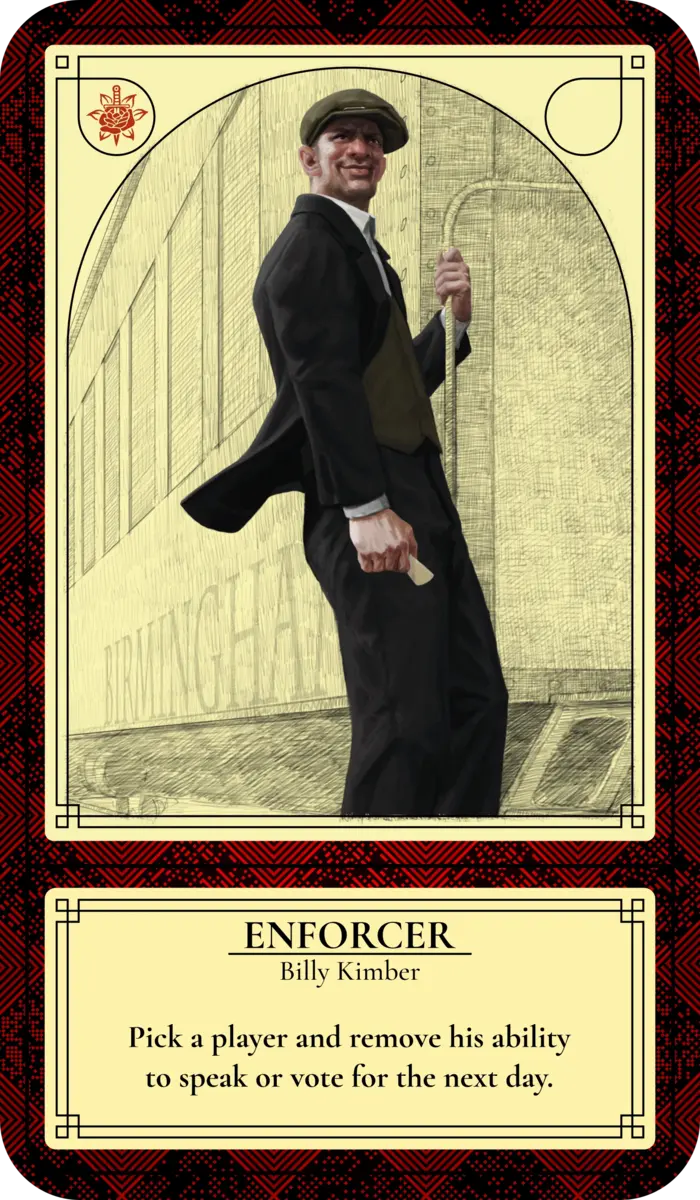
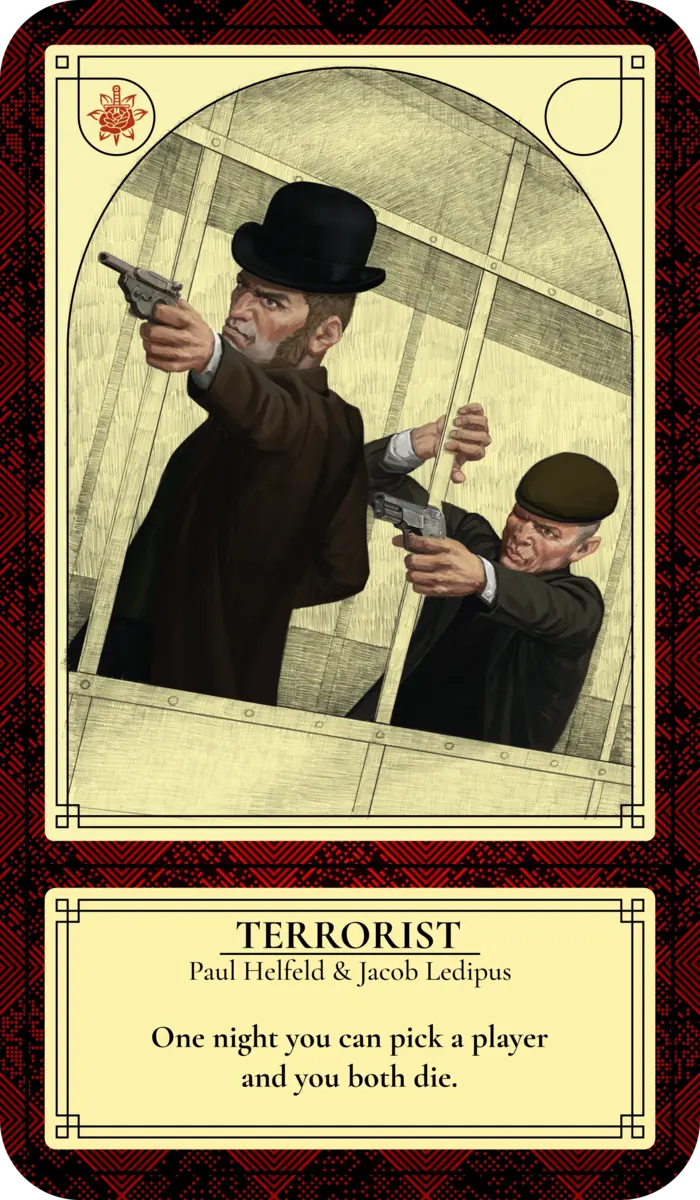
What this card does
Each night you pick a player and kill them. By day you look like everyone else.

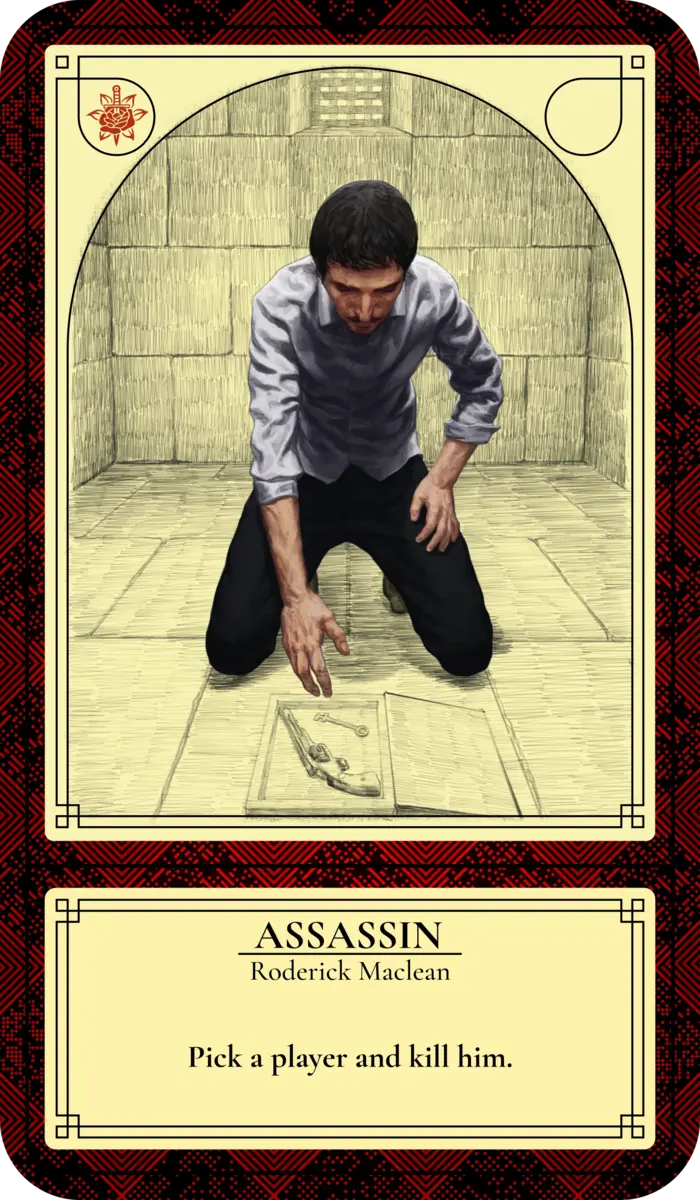
The Mafia Night Kill Each night 3 in the deck
What this card does
Each night you pick a player and kill them. By day you look like everyone else.
How to play
When the host calls the Assassins, open your eyes.
Pick a player each night and kill them.
Close your eyes. If more than one Assassin is seated, you pick one player together.
Tips
The Assassin is one of the mafia roles in the mafia party game.
In the box
Published mixes that seat this card. Pick the list that fits the room, then deal.
When only six friends could make it, you still light the lamp and put the lancet on the table. One knife is plenty in a room this close.
Someone found a seventh chair in the hall and the evening grew a little kinder. Same one knife, one more neighbour to talk to.
The teaching deal. Eight chairs, one lamp, one lancet — and two knives that already know each other.
Still one lamp — but now one door hits back. Call on the wrong house at night and you will wish you had sent a note.
The classic table of nine. Two killers, a cop, a doctor — and the vote does the rest.
For tables that like clues. Read the dead, check a team, and mind the Duelist’s duel.
One lamp, and it can be lied to. The Yard filed him under City, and the Yard is never wrong.
She points first, and somebody’s night simply does not happen. And the man at the door duels his callers.
The Bishop taxes the Assassins’ knife. The Terrorist’s exit does not go through the parish.
One seat raises the recently dead. One seat burns them off the roll. And the lamp may be lying.
The City gets tools, the Mafia gets tricks. You win this one as a table, not as four solo stars.
Gunn and Henry both in chairs, and a slab for everyone else. Two checks a night — while they live.
The client cannot be summoned. The job never happened. And the house still hits back.
Built for rooms that love to argue. Words win this deal — and careless words lose it.
A soldier with two shots, and a room daring him to spend both. The Lawyer would rather nobody stood trial at all.
Minutes are read at the end of the evening — and some names have been made unavailable.
The Oracle dies pointing. The Vigilante has two arguments of his own. The Terrorist needs only one.
Two checks a night. One of them may still be a kindness from Sabini.
The veterans’ deal. Twenty players, three Assassins, and a day that has to keep moving.
Warzone-sized, different firm. Two Assassins, a man the Yard already cleared, and a Bishop taxing the wrong knife.
Write every wake. Call them in the same order. The quiet ones in the dark are not all done with the evening.
Every useful face in a chair. Two more chairs take the last Citizens. After that the box really is empty.
The deck
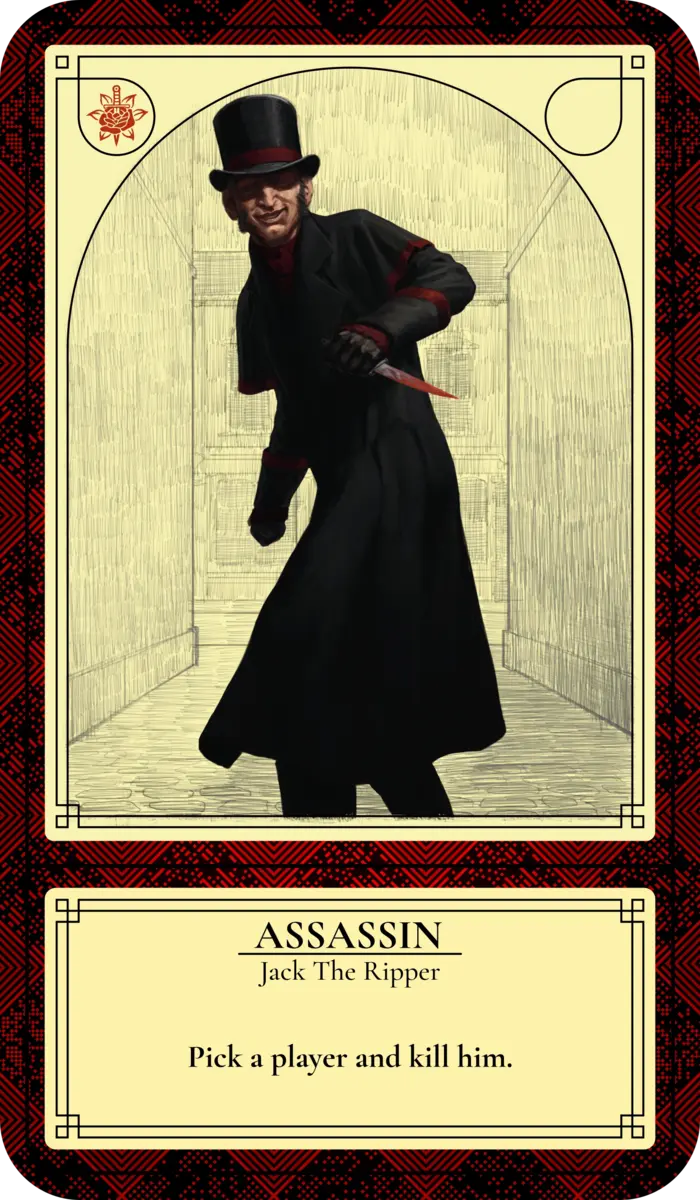
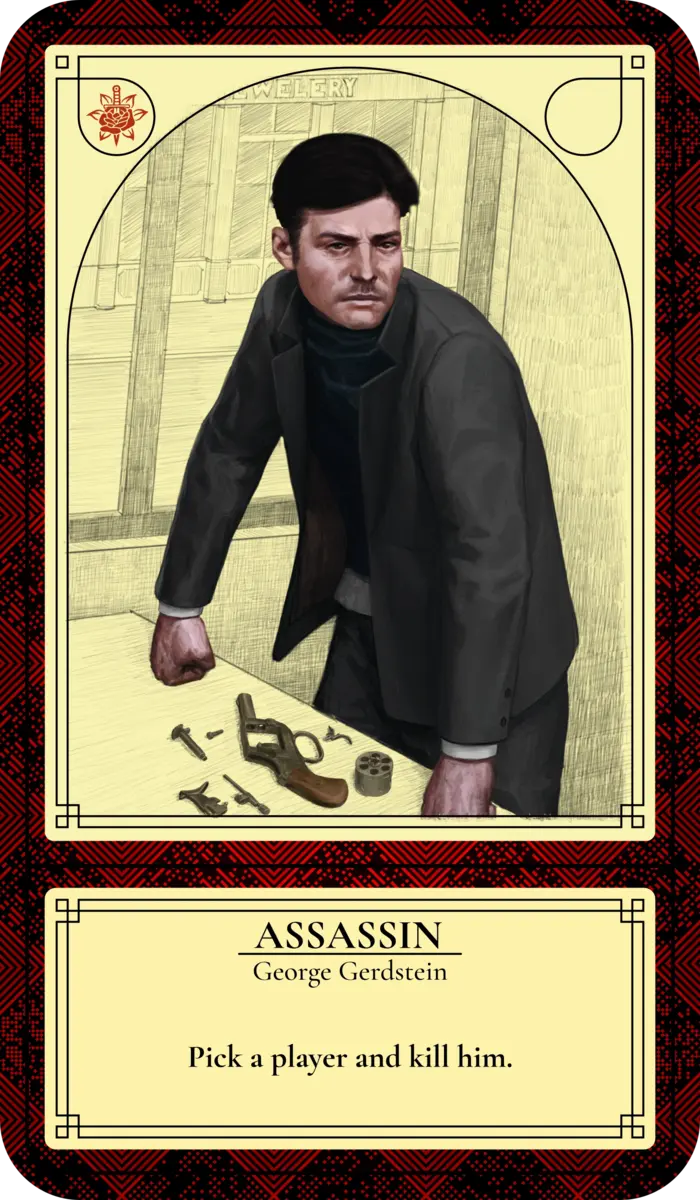
Assassin has 3 printed faces. The job is the same. Only the person on the card changes.
East End lore
The Assassin's best weapon is being overlooked. Roderick McLean once walked into a crowded railway station with a loaded revolver, stepped out of the crowd, and fired at Queen Victoria from ten feet away, and nobody had looked at him twice. He missed. Two schoolboys beat him down with their umbrellas. The Queen was so angry that the jury found him not guilty by reason of insanity that Parliament changed the wording of the law for her, and "guilty but insane" stayed on the books for eighty years. He fired one shot and rewrote a statute. That is the Assassin: an unremarkable face in the crowd, until the moment it isn't.
In the lore, Darby Sabini had him taken out of the asylum. It cost money in the right pockets and a certificate recording that McLean had done away with himself. The alliance wanted men nobody would miss, and there is no one harder to look for than a man already written off as dead. At the Three Harpies he sat among the rest, a man who should not have been anywhere.
“Everyone lies to me. That's why I like Mr Sabini. He promised to hang me.”
Roderick Mclean
Street
By day they buy drinks like anyone else. After dark, this is how the East End settled a problem.
Meeting
The Mafia needs a cut the table cannot see. This is that cut. The face still has to look ordinary in the morning.
The room
If the room smells blood, this is the first card they name. That is the job, and it is the danger.
Inspired by
c.1854–1921
He shot at Queen Victoria from ten feet away and changed the law of the land by missing. Windsor railway station, March 1882. The Queen had just left the train and was in her carriage when a man stepped out of the crowd with a revolver and fired. He missed. Two Eton schoolboys standing nearby beat him down with their umbrellas before the police reached him. It was the eighth and final attempt on her life across forty-two years, and it produced the outcome she found most satisfying: she said afterwards that it was worth being shot at to see how much she was loved. She was seated in a carriage. The whole thing took seconds.
The trial is the part that mattered. The jury found him not guilty on the grounds of insanity, and Victoria was furious — not because he went free, which he did not, but because of the wording. She wanted it on record that he had done it. Parliament changed the verdict formula to "guilty but insane," a phrase that survived in English law for the next eighty years, purely because a queen objected to the grammar of an acquittal. He was sent to Broadmoor, the asylum for the criminally insane, and stayed there until he died in 1921. He fired one shot and rewrote a statute.
He was already broken before he got there. He had suffered a serious head injury as a young man and was never the same afterwards; his family had him in and out of asylums, and by his twenties he was drifting, unemployed, writing poetry, and living on a small allowance that had been cut. He had written to the Queen. He believed he was owed a response and was being deliberately ignored, and what tipped him was ordinary and pathetic: money running out, letters unanswered, and the conviction that a personal wrong had been done to him by the most powerful person in the world. He bought the revolver. Nobody who knew him was surprised.
Thirty-nine years in Broadmoor followed, unremarkable and undocumented. He is remembered, when he is remembered at all, as a footnote to a legal reform he never understood he had caused.
Forget the missed shot and the umbrellas and the statute. Remember only this: he walked into a crowded railway station with a loaded revolver and nobody looked at him twice, because there was nothing about him worth looking at.
The Mafia
Same team. Different jobs.
Mafia is easier to play than it looks. Everyone gets a hidden card — most of the table is City, a hidden few are Mafia. At night the killers quietly pick a victim while a doctor tries to guess who needs saving and a cop digs for the truth. By day the survivors argue about what happened, put someone on trial, and vote. The City wins by finding every killer; the Mafia wins by surviving until they can win a vote. The walkthrough takes you through the whole game, from the deal to the last trial.
How to play mafiaYour first game should be The Lamp and the Lancet — eight players and only three night wakes, so nobody gets lost. With a ninth chair the same deal becomes, naturally, The Ninth Chair. All twenty published deals, up to twenty-seven players, are on the setups page.
The teaching deal. Eight chairs, one lamp, one lancet — and two knives that already know each other.
City: 1 Policeman, 1 Doctor, Citizens to fill Mafia: 2 Assassins
The classic table of nine. Two killers, a cop, a doctor — and the vote does the rest.
City: 1 Policeman, 1 Doctor, Citizens to fill Mafia: 2 Assassins