What this card does
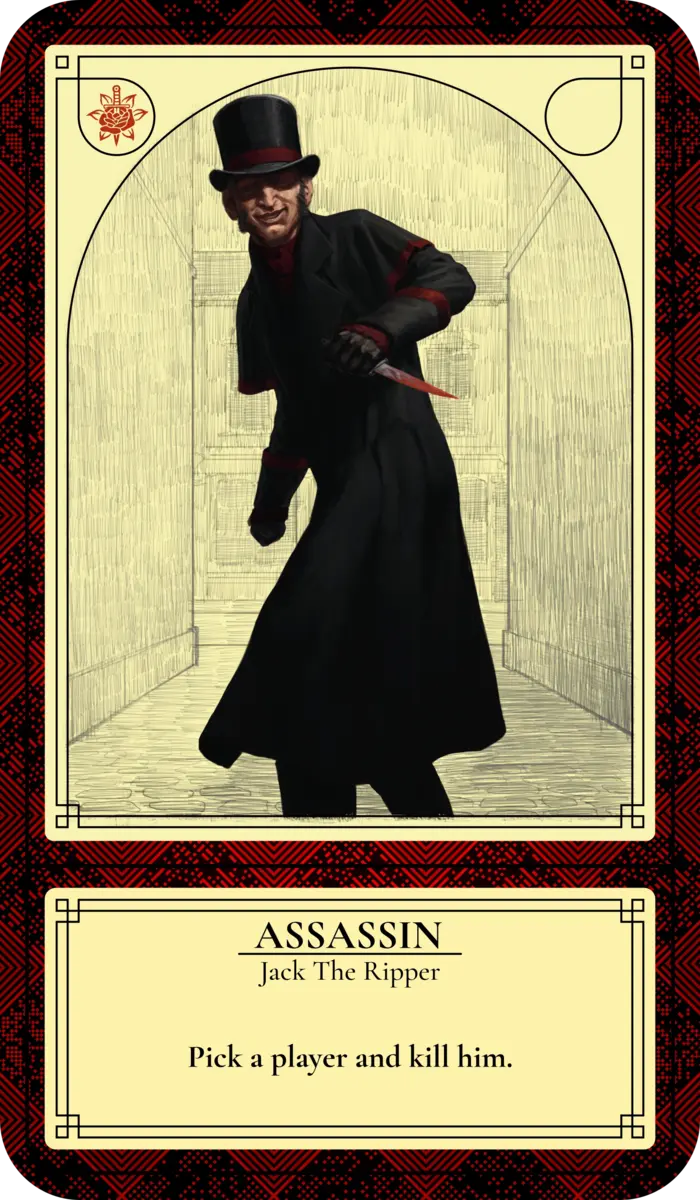
Each night you pick a player and kill them. By day you look like everyone else.

The Mafia Night Kill Each night 3 in the deck
What this card does
Each night you pick a player and kill them. By day you look like everyone else.
How to play
When the host calls the Assassins, open your eyes.
Pick a player each night and kill them.
Close your eyes. If more than one Assassin is seated, you pick one player together.
Tips
The Assassin is one of the mafia roles in the mafia party game.
In the box
Published mixes that seat this card. Pick the list that fits the room, then deal.
When only six friends could make it, you still light the lamp and put the lancet on the table. One knife is plenty in a room this close.
Someone found a seventh chair in the hall and the evening grew a little kinder. Same one knife, one more neighbour to talk to.
The teaching deal. Eight chairs, one lamp, one lancet — and two knives that already know each other.
Still one lamp — but now one door hits back. Call on the wrong house at night and you will wish you had sent a note.
The classic table of nine. Two killers, a cop, a doctor — and the vote does the rest.
For tables that like clues. Read the dead, check a team, and mind the Duelist’s duel.
One lamp, and it can be lied to. The Yard filed him under City, and the Yard is never wrong.
She points first, and somebody’s night simply does not happen. And the man at the door duels his callers.
The Bishop taxes the Assassins’ knife. The Terrorist’s exit does not go through the parish.
One seat raises the recently dead. One seat burns them off the roll. And the lamp may be lying.
The City gets tools, the Mafia gets tricks. You win this one as a table, not as four solo stars.
Gunn and Henry both in chairs, and a slab for everyone else. Two checks a night — while they live.
The client cannot be summoned. The job never happened. And the house still hits back.
Built for rooms that love to argue. Words win this deal — and careless words lose it.
A soldier with two shots, and a room daring him to spend both. The Lawyer would rather nobody stood trial at all.
Minutes are read at the end of the evening — and some names have been made unavailable.
The Oracle dies pointing. The Vigilante has two arguments of his own. The Terrorist needs only one.
Two checks a night. One of them may still be a kindness from Sabini.
The veterans’ deal. Twenty players, three Assassins, and a day that has to keep moving.
Warzone-sized, different firm. Two Assassins, a man the Yard already cleared, and a Bishop taxing the wrong knife.
Write every wake. Call them in the same order. The quiet ones in the dark are not all done with the evening.
Every useful face in a chair. Two more chairs take the last Citizens. After that the box really is empty.
The deck
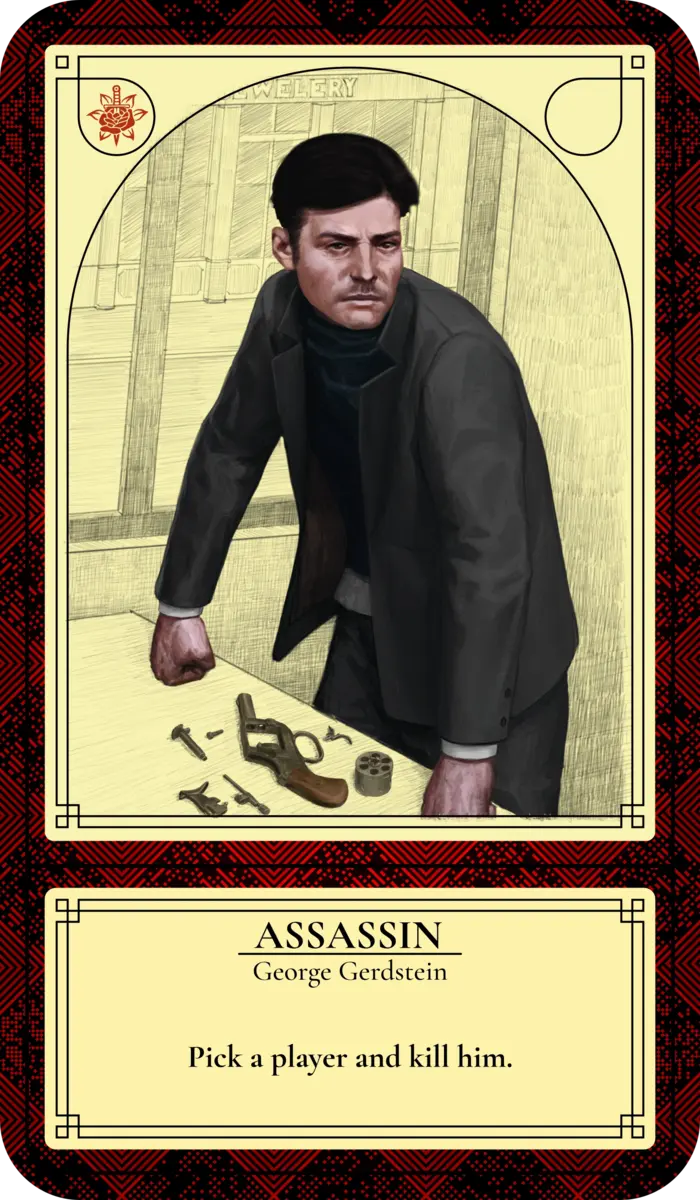
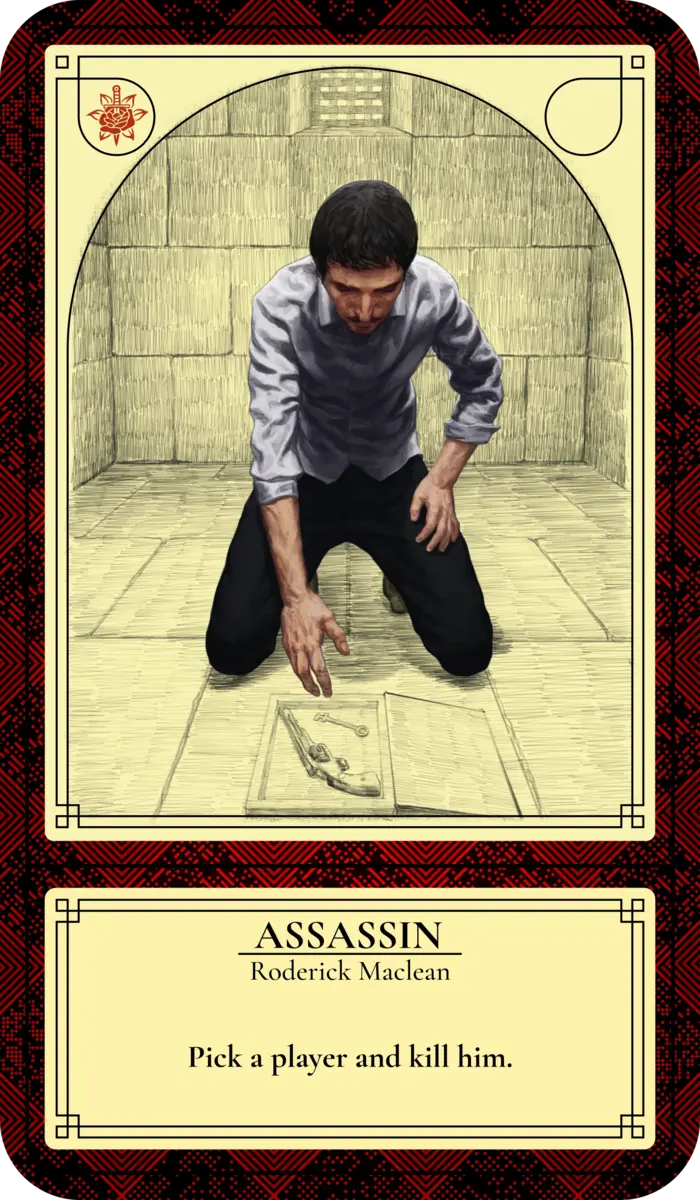
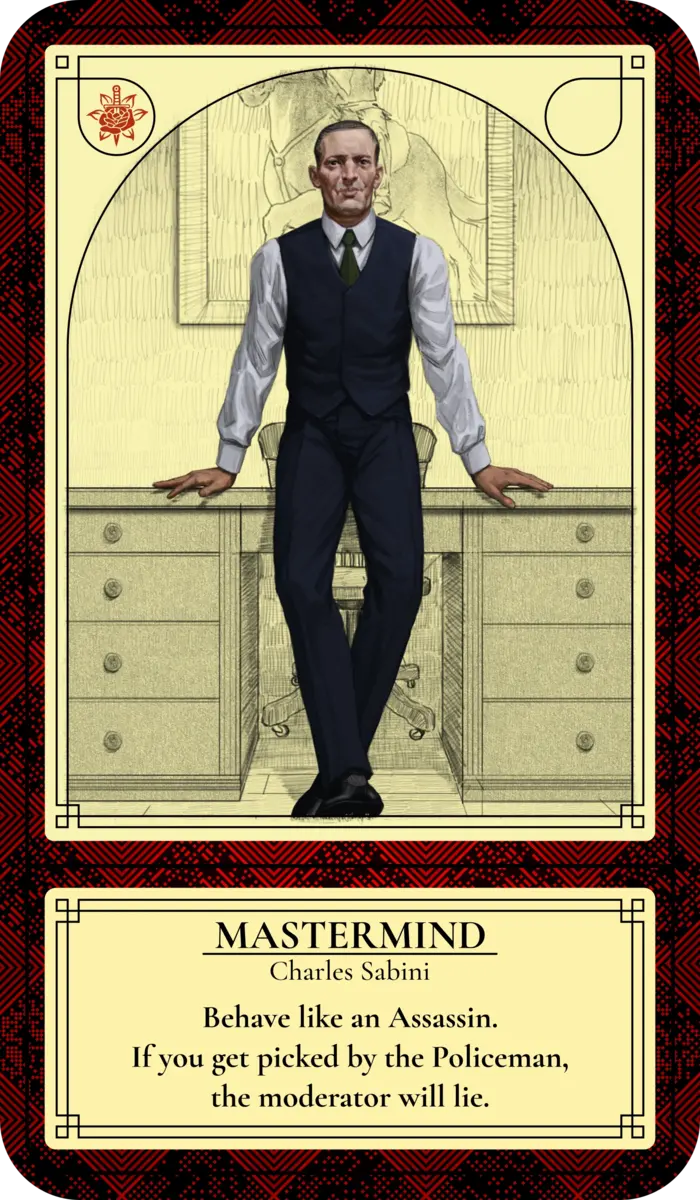
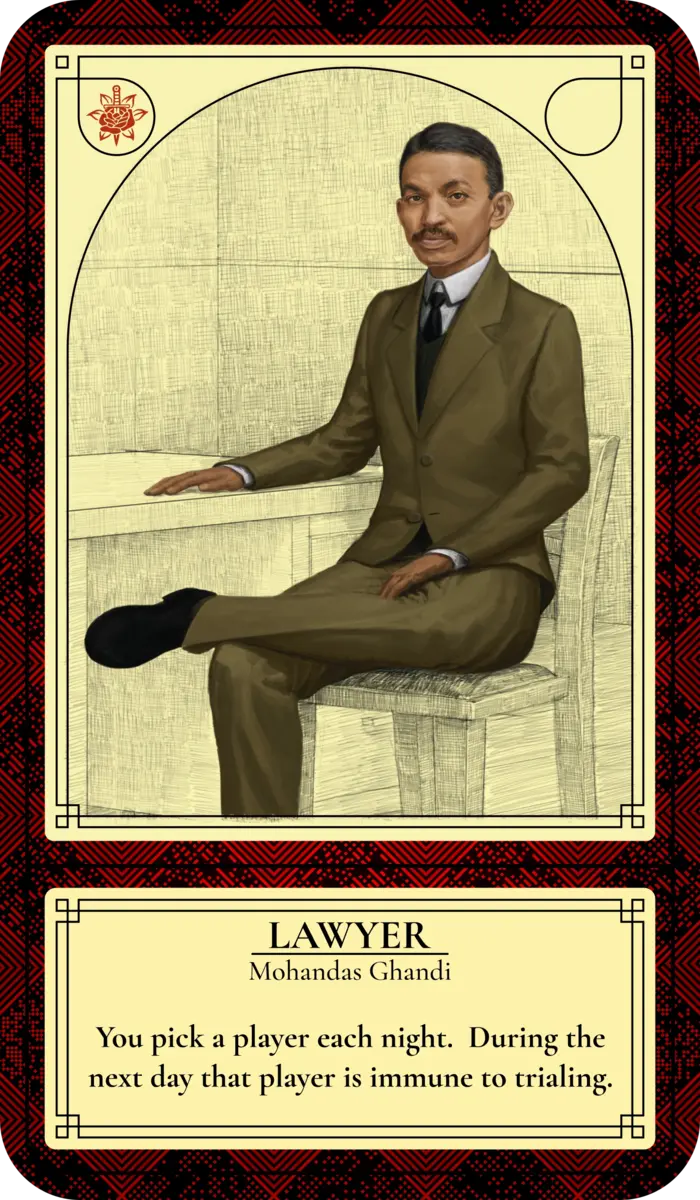
Assassin has 3 printed faces. The job is the same. Only the person on the card changes.
East End lore
The Assassin kills at night and survives the day by looking like everyone else. No one in history has done that better. He killed five women in Whitechapel in ten weeks: Mary Ann Nichols, Annie Chapman, Elizabeth Stride, Catherine Eddowes and Mary Jane Kelly. The largest manhunt the Metropolitan Police had ever mounted found nothing. Two forces, hundreds of suspects, bloodhounds, and vigilance committees walking the streets. On one night he killed, crossed into the next police district, and killed again within the hour. More than a hundred men have been named since and none of the names has held. That is the Assassin: the knife is the least of it. The real weapon is that nobody can tell him apart.
In the lore, Adam Worth went looking for him and found him. He put him in a room with two choices: more amusement than he had had in ten years, or something that was not a court. He took the first at once and thanked him. Worth kept him in the firm because he wanted him where he could see him. At the Three Harpies he sat at the end of the long table for five hours and was pleasant to a nurse. On the morning it went up, Worth went through that house opening doors to find him. He did not.
“Finally, a man in this city who takes his work as seriously as I take mine.”
Jack the Ripper
Street
By day they buy drinks like anyone else. After dark, this is how the East End settled a problem.
Meeting
The Mafia needs a cut the table cannot see. This is that cut. The face still has to look ordinary in the morning.
The room
If the room smells blood, this is the first card they name. That is the job, and it is the danger.
Inspired by
He killed five women in ten weeks and was never identified, and a hundred and forty years later he is still not identified. That is the whole of the fame: not the crimes, which were squalid, but the failure. The largest manhunt in the history of the Metropolitan Police to that date. Two police forces working the same square mile. Vigilance committees patrolling at night, bloodhounds trialled in Regent's Park, over two thousand people interviewed, three hundred investigated, eighty detained. Hundreds of letters from people claiming to be him, one of which supplied the name the world still uses. Nothing. No arrest, no charge, no name. The case file was closed with the same information it started with.
The victims were Mary Ann Nichols, Annie Chapman, Elizabeth Stride, Catherine Eddowes, and Mary Jane Kelly. They were poor women in Whitechapel who slept in common lodging houses at fourpence a night and went out after dark because they had not got the fourpence. Four of the five were killed in the open street or in a yard, in a district so densely populated that a scream should have brought twenty people. Nobody saw him arrive. Nobody saw him leave. In one instance he killed, was interrupted or thought he was, walked half a mile east into the neighbouring police jurisdiction, and killed again within the hour — two murders, two forces, one night. The medical men who examined the bodies argued over whether the man had anatomical training and never agreed. That argument is still running.
He worked because of where he chose. The East End in 1888 was the worst overcrowding in Britain: unlit courts, unpaved alleys, thousands of transient people with no fixed address and no reason to speak to the police, and a population so poor that the murders themselves became a national scandal chiefly because reporters finally went in and described the conditions. There was no fingerprinting yet. No forensic blood typing. No means of identifying a stranger who did not want to be identified. He required no disguise. In Whitechapel, an ordinary man walking at night was invisible by default.
Then it stopped. No confession, no deathbed statement, no reliable trace. Over the following century, more than a hundred people have been named as him: doctors, barbers, a painter, a member of the royal household, immigrants, madmen, and at least two men who happened to die conveniently soon afterwards. Every generation produces a new solution and none of them holds. The file remains open in the sense that it has never been closed by anyone who knew.
Forget the five nights and the manhunt and the century of theories. Remember only this: he stood in the middle of the most heavily watched square mile in England and nobody could tell him apart from anyone else — and that, not the knife, is what he actually was.
The Mafia
Same team. Different jobs.
Mafia is easier to play than it looks. Everyone gets a hidden card — most of the table is City, a hidden few are Mafia. At night the killers quietly pick a victim while a doctor tries to guess who needs saving and a cop digs for the truth. By day the survivors argue about what happened, put someone on trial, and vote. The City wins by finding every killer; the Mafia wins by surviving until they can win a vote. The walkthrough takes you through the whole game, from the deal to the last trial.
How to play mafiaYour first game should be The Lamp and the Lancet — eight players and only three night wakes, so nobody gets lost. With a ninth chair the same deal becomes, naturally, The Ninth Chair. All twenty published deals, up to twenty-seven players, are on the setups page.
The teaching deal. Eight chairs, one lamp, one lancet — and two knives that already know each other.
City: 1 Policeman, 1 Doctor, Citizens to fill Mafia: 2 Assassins
The classic table of nine. Two killers, a cop, a doctor — and the vote does the rest.
City: 1 Policeman, 1 Doctor, Citizens to fill Mafia: 2 Assassins