What this card does
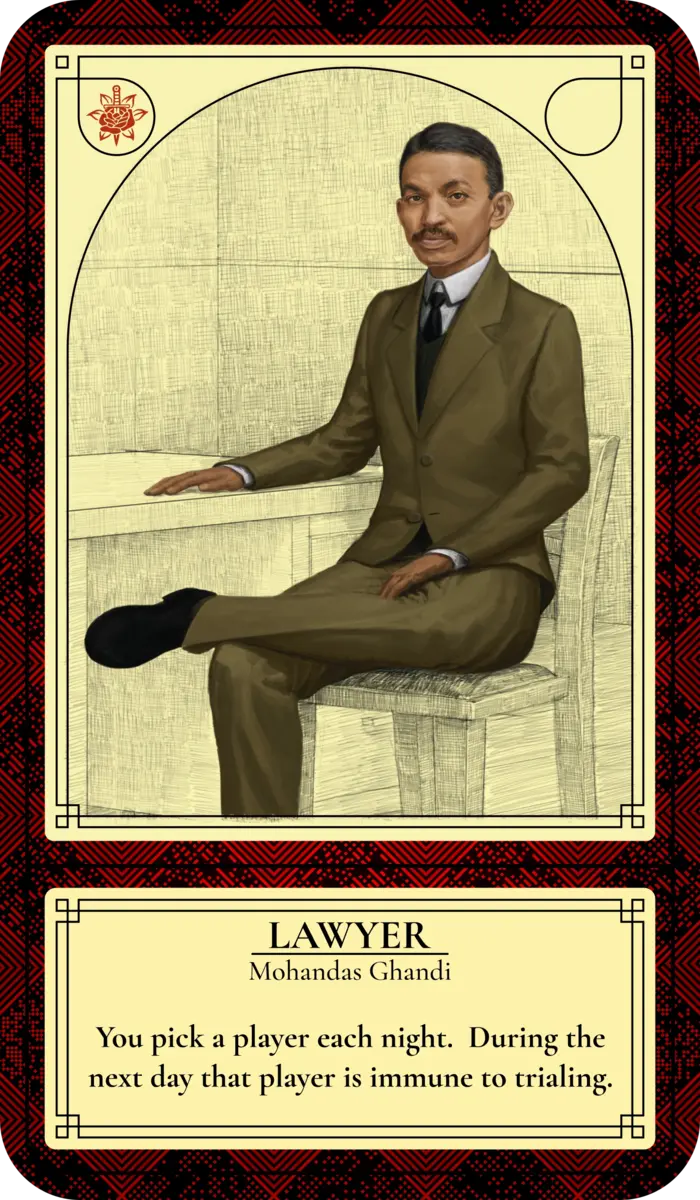
Each night you pick a player. They are immune to trial the next day.

The Mafia Night Block Each night
What this card does
Each night you pick a player. They are immune to trial the next day.
How to play
When the host calls the Lawyer, open your eyes.
Pick a player each night; they are immune to trial the next day.
Close your eyes. People may still talk about them. They cannot be tried that day.
Tips
The Lawyer is one of the mafia roles in the mafia party game.
In the box
Published mixes that seat this card. Pick the list that fits the room, then deal.
For tables that like clues. Read the dead, check a team, and mind the Duelist’s duel.
Gunn and Henry both in chairs, and a slab for everyone else. Two checks a night — while they live.
The client cannot be summoned. The job never happened. And the house still hits back.
Built for rooms that love to argue. Words win this deal — and careless words lose it.
A soldier with two shots, and a room daring him to spend both. The Lawyer would rather nobody stood trial at all.
Two checks a night. One of them may still be a kindness from Sabini.
Warzone-sized, different firm. Two Assassins, a man the Yard already cleared, and a Bishop taxing the wrong knife.
Write every wake. Call them in the same order. The quiet ones in the dark are not all done with the evening.
East End lore
The Lawyer protects one person each night, and the next day the table cannot put them on trial. Nobody in history understood the power of a rule better than Mohandas Gandhi. He trained as a barrister in London and went to South Africa on a one-year contract. There he was thrown off a train for sitting in a first-class carriage with a valid first-class ticket, and he stayed twenty-one years. Later, in India, he walked to the sea and picked up a lump of salt to break the Empire's monopoly on it, and sixty thousand people were arrested after him. Once, tried for sedition, he pleaded guilty, asked for the maximum sentence, and thanked the judge. That is the Lawyer: someone who knows exactly how the rules work, and can make them shield whoever he chooses.
In the lore, Adam Worth hired him deliberately. He did not want a crooked solicitor, since a crooked solicitor is only a liability with a practising certificate. He wanted a genuinely honest man who would look the part in any room: a young Indian lawyer lately back from South Africa, very correct, very poor, and entirely unaware of what he was holding. At the Three Harpies he drank lemonade. On the morning it all came apart, he stood perfectly still in the middle of the room with his eyes shut, repeating the same two syllables while men ran past him in both directions.
“Innocence is a matter of evidence. Evidence is a matter of paperwork.”
Mohandas Karamchand Gandhi
Street
East End solicitors who knew which names never reached a judge. Paper and favours instead of a knife.
Meeting
Some names never reach the vote. That is this seat’s craft. The room can still shout. It cannot finish the job today.
The room
People will still point. They just cannot put that chair on trial until the protection lifts. The delay is the weapon.
Inspired by
1869–1948
A half-naked man with a walking stick took apart the largest empire in human history, and he did it without ever striking anyone. The British ruled roughly a fifth of the world's population from London. He had no army, no party machine at the start, no money, and no office he could not resign from in an afternoon. He had a method: refuse, in public, in enormous numbers, and accept the beating. In 1930 he walked two hundred and forty miles to the sea over twenty-four days, picked up a lump of salt from the shore, and broke the law by doing it — because the Empire held a monopoly on salt in a country where nobody could live without it. Sixty thousand people were arrested in the weeks that followed. He was photographed the whole way.
His actual weapon was legal training and total public exposure. He knew the law, he knew exactly which statute he was breaking and how the prosecution would run, and he made certain the world was watching while it happened. At Dharasana, marchers walked in columns toward police lines and were clubbed down without raising their hands, and an American correspondent cabled the description to a thousand newspapers. Gandhi went to prison repeatedly and used the sentences. He fasted — publicly, dangerously, for weeks — until governments and communities moved, and he did it knowing that his own death would be a political event more powerful than his life. When a British court tried him for sedition in 1922 he pleaded guilty, invited the maximum sentence, and thanked the judge. The judge sentenced him and said he would be glad if the government released him early.
He learned all of it as a suited barrister in South Africa. He was a shy young lawyer, trained in London at the Inner Temple, who went to Natal on a one-year commercial contract for an Indian trading firm. He was thrown off a train at Pietermaritzburg for sitting in a first-class carriage with a valid first-class ticket, and he sat in the cold on the station platform all night. He was twenty-four. He stayed in South Africa twenty-one years and built the method there — mass registration refusals, burning identity certificates, marches, prison — on behalf of Indian merchants and indentured labourers who had no standing at all.
He came home in 1915 and spent the next three decades as the moral centre of the independence movement, and he watched it end in a partition he opposed and a million dead in communal violence he could not stop. In January 1948 he was shot three times at close range by a Hindu nationalist who considered him too accommodating to Muslims. India had been independent for five months.
Forget the empire and the salt and the fasts. Remember only this: he was a lawyer to the bone, and his entire life's work was the discovery that a rule, followed exactly and in public, can be made to break the man who wrote it.
The Mafia
Same team. Different jobs.
Mafia is easier to play than it looks. Everyone gets a hidden card — most of the table is City, a hidden few are Mafia. At night the killers quietly pick a victim while a doctor tries to guess who needs saving and a cop digs for the truth. By day the survivors argue about what happened, put someone on trial, and vote. The City wins by finding every killer; the Mafia wins by surviving until they can win a vote. The walkthrough takes you through the whole game, from the deal to the last trial.
How to play mafiaYour first game should be The Lamp and the Lancet — eight players and only three night wakes, so nobody gets lost. With a ninth chair the same deal becomes, naturally, The Ninth Chair. All twenty published deals, up to twenty-seven players, are on the setups page.
The teaching deal. Eight chairs, one lamp, one lancet — and two knives that already know each other.
City: 1 Policeman, 1 Doctor, Citizens to fill Mafia: 2 Assassins
The classic table of nine. Two killers, a cop, a doctor — and the vote does the rest.
City: 1 Policeman, 1 Doctor, Citizens to fill Mafia: 2 Assassins