What this card does
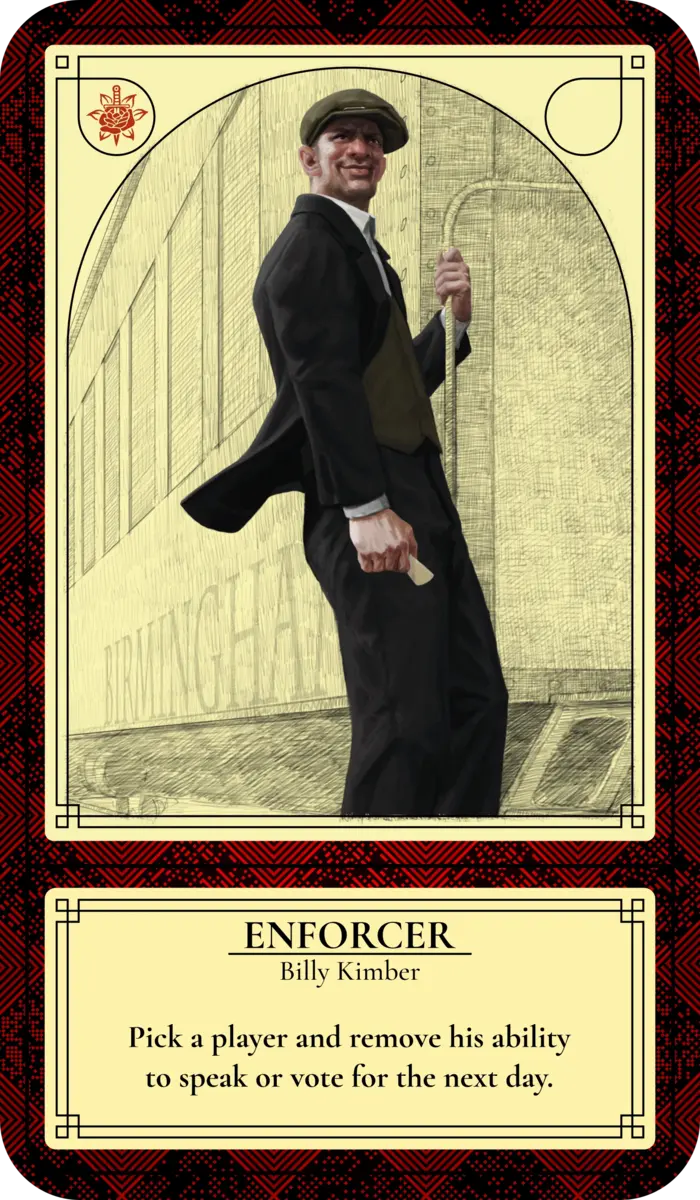
Each night you pick a player and remove their ability to speak or vote the next day.

The Mafia Night Block Each night
What this card does
Each night you pick a player and remove their ability to speak or vote the next day.
How to play
When the host calls the Enforcer, open your eyes.
Pick a player each night and remove their ability to speak or vote the next day.
Show the host speak or vote. Then close your eyes.
Tips
The Enforcer is one of the mafia roles in the mafia party game.
In the box
Published mixes that seat this card. Pick the list that fits the room, then deal.
For tables that like clues. Read the dead, check a team, and mind the Duelist’s duel.
Gunn and Henry both in chairs, and a slab for everyone else. Two checks a night — while they live.
Built for rooms that love to argue. Words win this deal — and careless words lose it.
A soldier with two shots, and a room daring him to spend both. The Lawyer would rather nobody stood trial at all.
Minutes are read at the end of the evening — and some names have been made unavailable.
The Oracle dies pointing. The Vigilante has two arguments of his own. The Terrorist needs only one.
The veterans’ deal. Twenty players, three Assassins, and a day that has to keep moving.
Every useful face in a chair. Two more chairs take the last Citizens. After that the box really is empty.
East End lore
The Enforcer doesn't kill. He chooses one player each night and takes away their voice or their vote for the next day. Billy Kimber understood that the point is not to hurt a man but to make him quiet. He came out of one of Birmingham's poorest streets, worked as a brass caster, and rose through the back-to-back gangs to run the largest racecourse protection operation outside London. At his height he could put hundreds of men on a train. Once he was shot in the stomach at close range in a London street and told the police he had no idea who had done it. He knew exactly who had done it. That is the Enforcer: nothing settled by anyone in a uniform, and everyone made to keep quiet.
In the lore, Darby Sabini went to Birmingham himself and brought him back. The two men had been rivals, and nobody else alive could have made that journey and returned with Kimber beside him. With Birmingham in, the alliance held the north and the south, and the East End stopped fighting itself. He walked into the Three Harpies in a suit that cost more than the house.
“Paint me as I am. Kimber didn't come to London to be anybody else.”
Billy Kimber
Street
Razors and racecourse firms. In 1900, making a man quiet was a living, and a warning that walked around afterwards.
Meeting
A voice can vanish from the table. So can a vote. The room feels the hole and may not know why it is there.
The room
A silent neighbour is not always guilty. Sometimes they were made quiet. The table has to tell those two apart.
Inspired by
1882–1949
He was shot in the stomach at close range in a London street and told the police he had no idea who did it. He knew exactly who did it. That refusal was the whole man: Billy Kimber ran the largest racecourse protection operation in Britain outside London, and he ran it on the understanding that nothing was ever settled by anybody in a uniform. He controlled the northern and midland tracks — the bookmakers' pitches, the chalk, the stools, the lists, the levy on every man taking bets in a field — and he did it by being the person other hard men agreed to work for. At his height he could put hundreds of men on a train.
The instruments were simple and the intent was not to kill. Razors, hammers, iron bars, and coshes; the razor was the signature, because a cut face is a message that walks around afterwards. His men worked the courses at Birmingham, Doncaster, Newcastle, and the whole northern circuit, and when the Sabini organisation moved on the southern tracks the two firms fought openly for years. The worst of it came at Epsom in 1921, when a Birmingham convoy was ambushed in a country lane by a hundred men and beaten in daylight, and at Alexandra Park, and on the trains, and in the station yards. Twenty-three men went to prison for the Epsom ambush. Kimber himself was assaulted repeatedly, shot once, and convicted of almost nothing.
He came out of a Birmingham slum. Summer Lane, one of the poorest streets in the city, a family that moved between addresses because rent was what you owed and left behind. He worked as a brass caster and as a labourer, and he came up through the street gangs of the 1890s — the loose, brutal, territorial mobs of the Birmingham back-to-backs — where a boy learned to fight before he learned a trade. What separated him from a thousand others in the same streets was that he could organise. He worked out that the money was not in the fighting. It was in the arrangement that stops the fighting, sold weekly, to people who needed a field to work in.
He drifted out of it in the twenties. He moved south, kept business interests in bookmaking, made peace where peace was cheaper, and died in Torquay in 1945, respectable enough on paper, with an estate to leave. His name was largely forgotten until a television series made it famous and got most of the details wrong.
Forget the tracks and the razors and the hundreds of men. Remember only this: he understood earlier than anyone that the point is not to hurt a man — it is to make him quiet, and keep him quiet, for as long as you need him to be.
The Mafia
Same team. Different jobs.
Mafia is easier to play than it looks. Everyone gets a hidden card — most of the table is City, a hidden few are Mafia. At night the killers quietly pick a victim while a doctor tries to guess who needs saving and a cop digs for the truth. By day the survivors argue about what happened, put someone on trial, and vote. The City wins by finding every killer; the Mafia wins by surviving until they can win a vote. The walkthrough takes you through the whole game, from the deal to the last trial.
How to play mafiaYour first game should be The Lamp and the Lancet — eight players and only three night wakes, so nobody gets lost. With a ninth chair the same deal becomes, naturally, The Ninth Chair. All twenty published deals, up to twenty-seven players, are on the setups page.
The teaching deal. Eight chairs, one lamp, one lancet — and two knives that already know each other.
City: 1 Policeman, 1 Doctor, Citizens to fill Mafia: 2 Assassins
The classic table of nine. Two killers, a cop, a doctor — and the vote does the rest.
City: 1 Policeman, 1 Doctor, Citizens to fill Mafia: 2 Assassins