What this card does
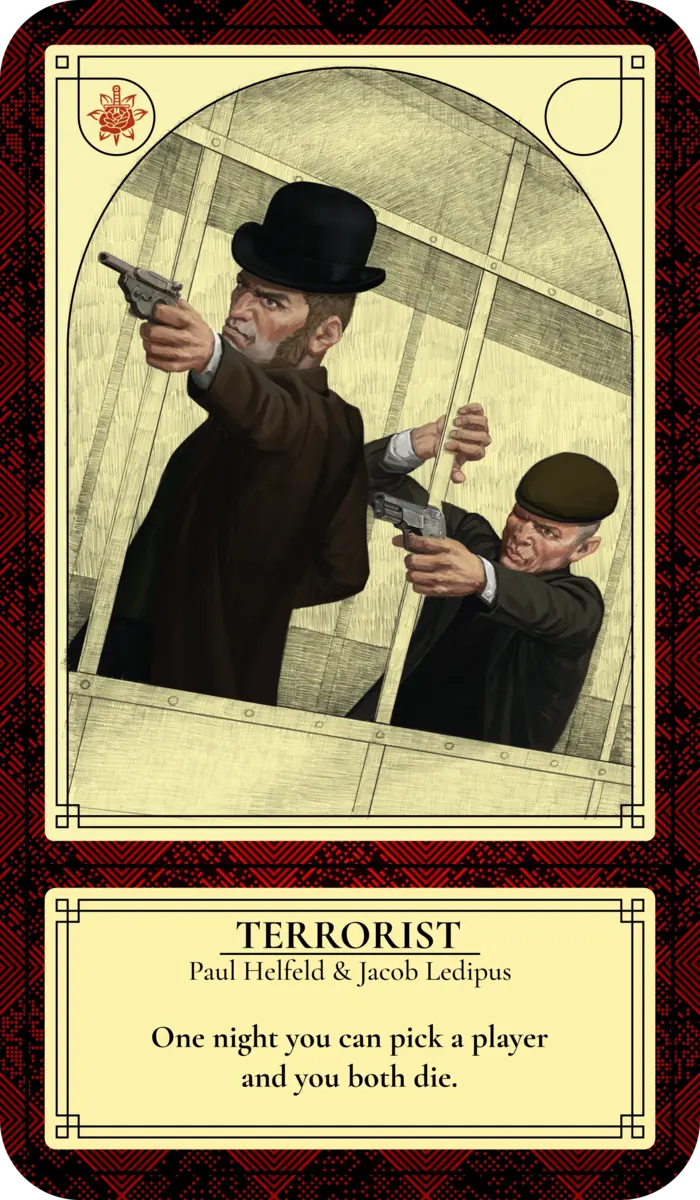
Once per game you pick a player. You both die.

The Mafia Night Kill Once per game
What this card does
Once per game you pick a player. You both die.
How to play
When the host calls the Terrorist, open your eyes.
Once per game, pick a player; you both die.
Close your eyes. You do not have to use it. Once you point, you both die.
Tips
The Terrorist is one of the mafia roles in the mafia party game.
In the box
Published mixes that seat this card. Pick the list that fits the room, then deal.
The Bishop taxes the Assassins’ knife. The Terrorist’s exit does not go through the parish.
The Oracle dies pointing. The Vigilante has two arguments of his own. The Terrorist needs only one.
The veterans’ deal. Twenty players, three Assassins, and a day that has to keep moving.
Warzone-sized, different firm. Two Assassins, a man the Yard already cleared, and a Bishop taxing the wrong knife.
Every useful face in a chair. Two more chairs take the last Citizens. After that the box really is empty.
East End lore
Once a game, the Terrorist picks a player, and they both die. Paul Helfeld and Jacob Lepidus never imagined a morning in which they simply walked away. They were Latvian exiles from a failed revolution against the Tsar, and once, in north London, they robbed a factory wages clerk and ran. They went on foot, then by hijacked tram, then by milk cart and greengrocer's van, firing over their shoulders for six miles and two hours. Roughly four hundred rounds were fired. A ten-year-old boy and a police constable were killed. When they were cornered, both men turned their pistols on themselves rather than be taken. That is the Terrorist: they never plan to survive. The only choice they make is who comes with them.
In the lore, Adam Worth took them on himself. Some jobs want men who cannot be reasoned with, and he would rather know where those two were than not. He told them to stay outside the Three Harpies, and they did not. On the morning the shooting started, the young soldier ran down the cellar stair towards the screaming. Lepidus went after him four or five seconds later, and Helfeld followed on the stair behind. Worth never learned whether they went down to stop him, to help him, or for some reason of their own. He never saw any of the three again.
“We are not your men, Mr Worth. We are your receipt.”
Paul Helfeld & Jacob Lepidus
Street
The East End knew men who would rather burn with a rival than lose. One move. Two chairs empty.
Meeting
This seat is a door you only open once. Opening it costs both people. That is why the table watches it.
The room
The table will dare you to use it. Your own side will tell you when. A wasted door is still a door you no longer have.
Inspired by
d. 1909
Two men robbed a factory wages clerk in north London and turned the whole of Tottenham into a running battlefield for six miles and two hours, and both of them shot themselves rather than be taken. January 1909. They took a bag of cash outside a rubber works, opened fire immediately, and then ran — on foot, then by hijacked tram, then by milk cart, then by greengrocer's van, then on foot again — firing over their shoulders the entire way at police, at civilians, at anyone who came near. Roughly four hundred rounds were fired that morning. A ten-year-old boy was killed. A police constable was killed. Somewhere around two dozen people were wounded. Neither man was ever going to stop running, and neither had any intention of being arrested.
The chase became a public spectacle because ordinary Londoners joined in. Police carrying truncheons borrowed revolvers and shotguns from gunsmiths and passers-by, some of them badly maintained, some of the ammunition wrong for the weapon. Men on bicycles pursued a hijacked tram. A crowd followed on foot across marshland. The two robbers had Bergmann and Browning pistols and were competent with them; the pursuit had whatever it could find. Lepidus was cornered in a cottage at Oak Cottage, Hale End, and shot himself as the police closed in. Helfeld, hit at a fence, put his own pistol to his head and lingered three weeks before dying in hospital. It became known as the Tottenham Outrage, and it changed British policing: it is a direct reason the Metropolitan Police began seriously reconsidering how officers were armed.
They were Latvians who had fled the crushed 1905 revolution against the Russian Tsar, and they arrived into the same East End world of sweatshops, boarding houses, and political exile that produced Gardstein two years later. Lepidus had a brother who had blown himself up in Paris carrying a bomb intended for a French official. The money was expropriation — funds taken for the cause, not for themselves — which was doctrine, and by the time it reached a rubber works payroll in Tottenham the doctrine had worn down into two men, one bag, and no plan for afterwards.
The political consequence landed on people who had nothing to do with it. The press treated it as proof that the country had let in something dangerous, and the argument fed straight into the immigration politics that followed. The two men are buried without ceremony and remembered under a name given to them by a newspaper.
Forget the four hundred rounds and the six miles. Remember only this: they never once considered a version of that morning in which they walked away — they simply decided who was going with them.
The Mafia
Same team. Different jobs.
Mafia is easier to play than it looks. Everyone gets a hidden card — most of the table is City, a hidden few are Mafia. At night the killers quietly pick a victim while a doctor tries to guess who needs saving and a cop digs for the truth. By day the survivors argue about what happened, put someone on trial, and vote. The City wins by finding every killer; the Mafia wins by surviving until they can win a vote. The walkthrough takes you through the whole game, from the deal to the last trial.
How to play mafiaYour first game should be The Lamp and the Lancet — eight players and only three night wakes, so nobody gets lost. With a ninth chair the same deal becomes, naturally, The Ninth Chair. All twenty published deals, up to twenty-seven players, are on the setups page.
The teaching deal. Eight chairs, one lamp, one lancet — and two knives that already know each other.
City: 1 Policeman, 1 Doctor, Citizens to fill Mafia: 2 Assassins
The classic table of nine. Two killers, a cop, a doctor — and the vote does the rest.
City: 1 Policeman, 1 Doctor, Citizens to fill Mafia: 2 Assassins