What this card does
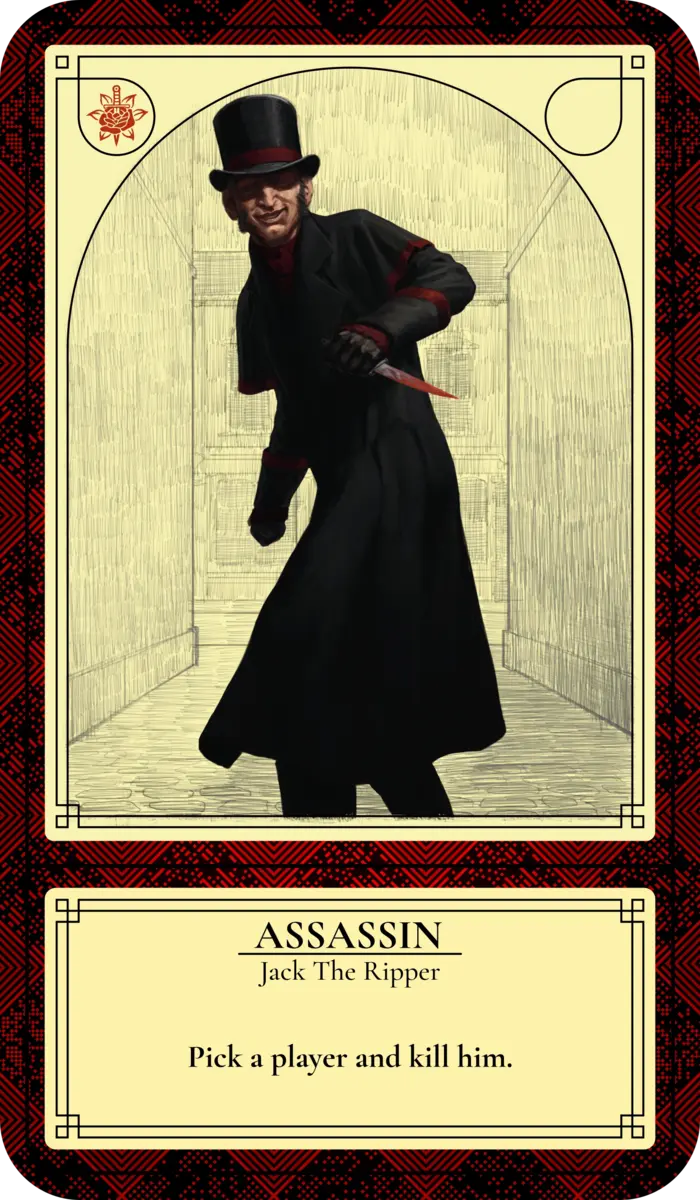
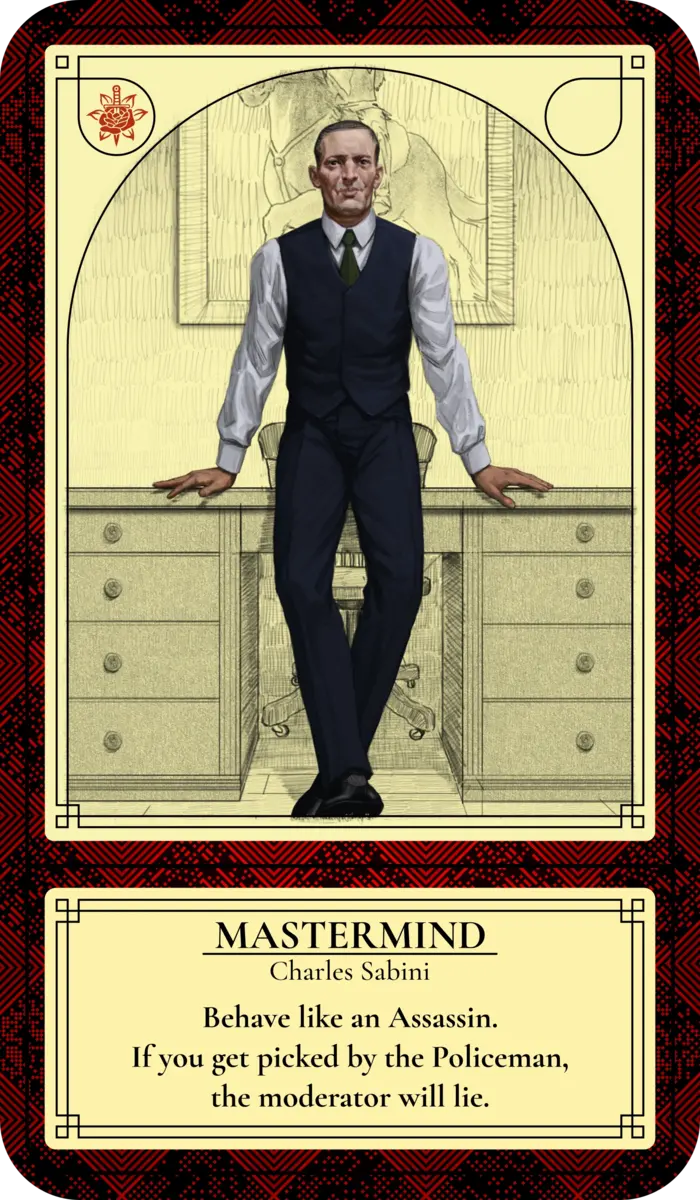
You act as an assassin: pick a player each night and kill them. If the Policeman picks you, the moderator lies about your faction.

The Mafia Night Kill Each night
What this card does
You act as an assassin: pick a player each night and kill them. If the Policeman picks you, the moderator lies about your faction.
How to play
You act as an assassin. Pick a player each night and kill them.
If picked by the Policeman, the moderator lies about your faction.
Close your eyes. Hunt with the assassins when that wake is called.
Tips
The Mastermind is one of the mafia roles in the mafia party game.
In the box
Published mixes that seat this card. Pick the list that fits the room, then deal.
One lamp, and it can be lied to. The Yard filed him under City, and the Yard is never wrong.
One seat raises the recently dead. One seat burns them off the roll. And the lamp may be lying.
Two checks a night. One of them may still be a kindness from Sabini.
Warzone-sized, different firm. Two Assassins, a man the Yard already cleared, and a Bishop taxing the wrong knife.
Write every wake. Call them in the same order. The quiet ones in the dark are not all done with the evening.
Every useful face in a chair. Two more chairs take the last Citizens. After that the box really is empty.
East End lore
The Mastermind kills like any Assassin, but when the Policeman looks at him the answer comes back clean. Darby Sabini ran the racecourses of southern England for a decade and never held a title or a stake in anything a court could name. Every bookmaker needed a pitch, chalk, a stool and a list, and Sabini's men sold all of it at a price nobody argued with. He was never convicted of running any of it. In a trade where everyone lied as a matter of routine, he ran it all on one rule: he kept his word, and never promised the same thing to two men. That is the Mastermind: the most dangerous man in the room, and the one who looks most like a respectable citizen.
In the lore, Adam Worth brought him a serious proposition, and Sabini made it real. He went to Birmingham himself and came back with Billy Kimber, and he bought McLean out of the asylum and put his protection around Gardstein. When the City's people began meeting in a back room, he did not raid it. He bought that public house and the Three Harpies too, closed the first for repairs, and let them walk into the second of their own accord. On the night, he stood behind his own bar in shirtsleeves, pulling their beer. Nobody looks at a publican.
“I don't make threats. Threats are for men who intend to negotiate.”
Darby Sabini
Street
Not every boss pulls a trigger. The East End had men who only arranged who did — and still ran the night.
Meeting
This seat sits with the killers and looks like the safest chair in the room. That is the whole point of it.
The room
The table will want a simple killer. This card is not simple. A cop who trusts this face has already lost ground.
Inspired by
1888–1950
He ran the racecourses of southern England for a decade and never held a title, an office, or a stake in anything a court could name. That was the design. Every bookmaker at every meeting needed a pitch, chalk, a bucket of water, a stool, and a printed list — and Sabini's men supplied all of it, at a price, and the price was not negotiable. Refuse and your pitch was unusable. Pay and nothing happened to you. It was protection sold as a service, and it was so complete that at its height his organisation took a levy from virtually every bookmaker working the tracks from Epsom to Brighton. He controlled it without ever once being convicted of running it.
The war for it was open and violent. Rival firms came down from Birmingham and up from the East End, and the fighting was done with razors sewn into cap peaks, hammers, and iron bars, at Epsom, at Alexandra Park, at Lewes, in station yards and on the trains carrying men home from a meeting. He held it because he was better organised than the opposition: he brought in Sicilian and Italian muscle from Clerkenwell, he had a working relationship with a good many racecourse police, and he kept a stable of lawyers who turned up before the charges did. And he ran it on a principle that made him rare in that trade — he kept his word. Men who dealt with Sabini were paid what they had been promised, on time, and he did not promise the same thing to two men. In a business where everyone lies as a matter of routine, being reliable was itself a form of power.
He came out of Saffron Hill, the Italian quarter of Clerkenwell, one of six brothers, with an Italian father who died young and an English mother who raised them poor. He boxed as a young man and was good enough to be noticed and not good enough to matter. What put him in business was ordinary: he took work as a strong-arm for a club owner, discovered he had a head for organisation that nobody around him had, and understood before anyone else did that the money at a racecourse is not in the horses. It is in the fact that hundreds of men must stand in a field with cash in their hands and no protection whatsoever.
The end was bureaucratic. He was interned in 1940 as an enemy alien despite being born in London — a detail that finished his standing — and his son was killed serving in the RAF. He was convicted of receiving stolen goods after the war, served his sentence, and died in Hove in 1950, at a boarding house, broke.
Forget the racecourses and the razors and the decade at the top. Remember only this: he built the whole thing on being a man whose word could be relied upon absolutely — which meant that when somebody finally decided to use him, he never thought to check.
The Mafia
Same team. Different jobs.
Mafia is easier to play than it looks. Everyone gets a hidden card — most of the table is City, a hidden few are Mafia. At night the killers quietly pick a victim while a doctor tries to guess who needs saving and a cop digs for the truth. By day the survivors argue about what happened, put someone on trial, and vote. The City wins by finding every killer; the Mafia wins by surviving until they can win a vote. The walkthrough takes you through the whole game, from the deal to the last trial.
How to play mafiaYour first game should be The Lamp and the Lancet — eight players and only three night wakes, so nobody gets lost. With a ninth chair the same deal becomes, naturally, The Ninth Chair. All twenty published deals, up to twenty-seven players, are on the setups page.
The teaching deal. Eight chairs, one lamp, one lancet — and two knives that already know each other.
City: 1 Policeman, 1 Doctor, Citizens to fill Mafia: 2 Assassins
The classic table of nine. Two killers, a cop, a doctor — and the vote does the rest.
City: 1 Policeman, 1 Doctor, Citizens to fill Mafia: 2 Assassins