What this card does
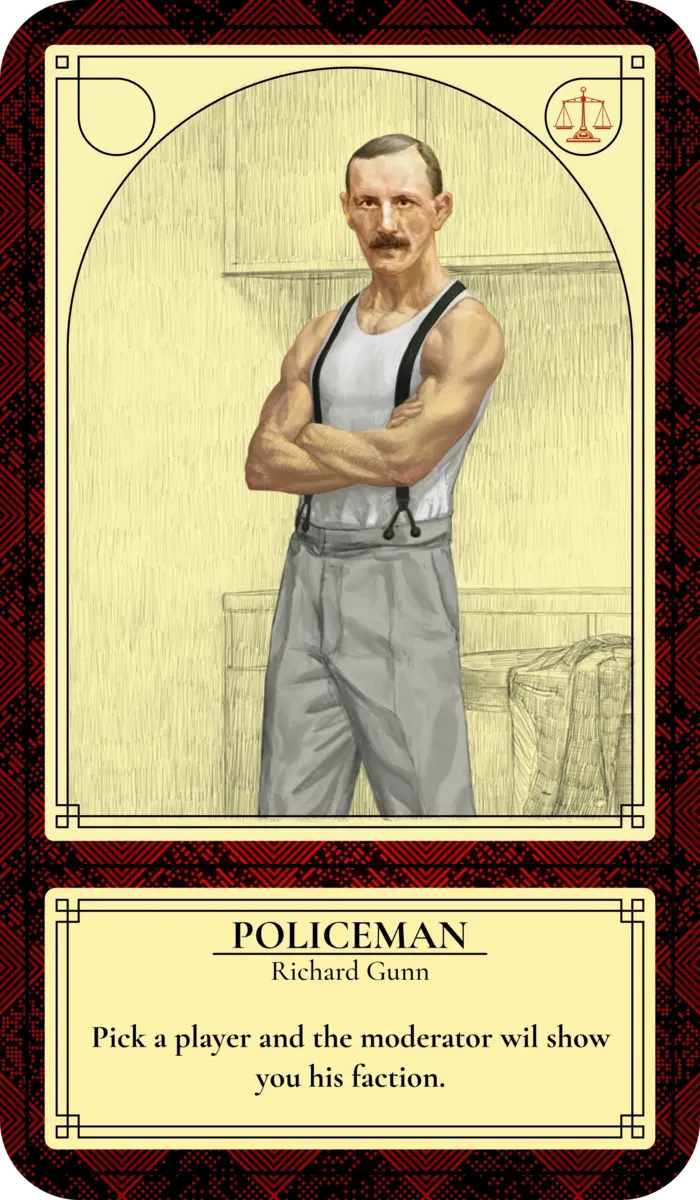
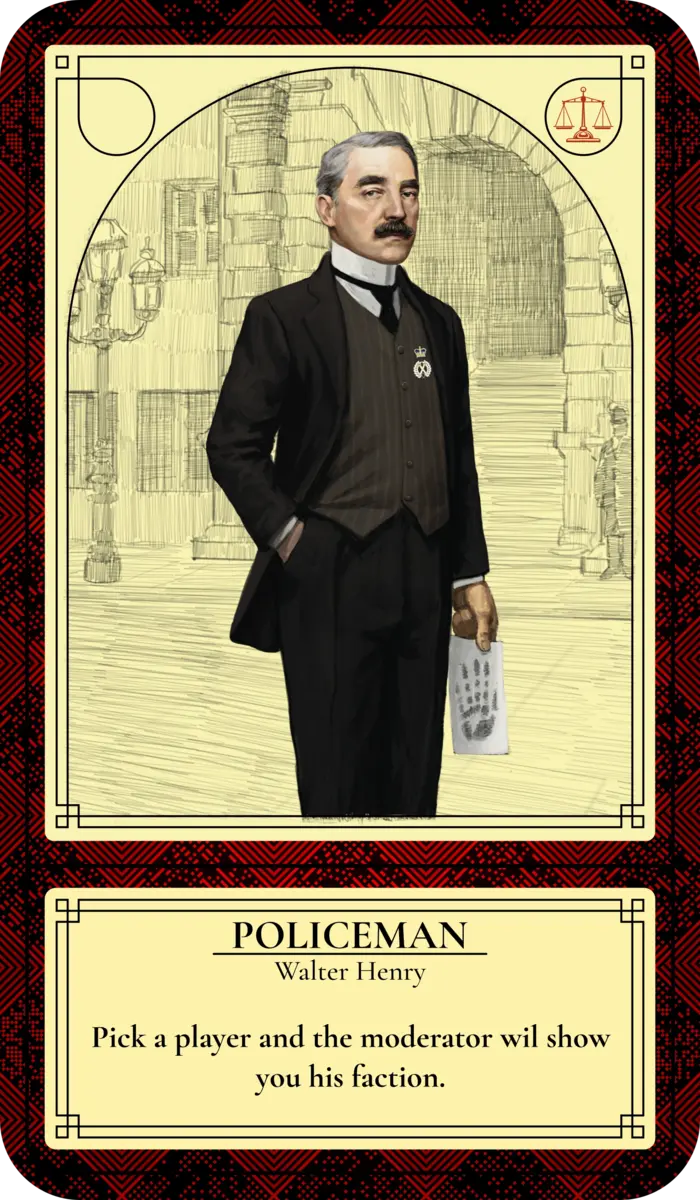
Each night you pick a player. The moderator reveals their faction: City or Mafia.

The City Night Investigate Each night 2 in the deck
What this card does
Each night you pick a player. The moderator reveals their faction: City or Mafia.
How to play
When the host calls the Policeman, open your eyes.
Pick a player each night; the moderator reveals their faction.
Close your eyes. You learned a team, not a role name.
Tips
The Policeman is one of the mafia roles in the mafia party game.
In the box
Published mixes that seat this card. Pick the list that fits the room, then deal.
When only six friends could make it, you still light the lamp and put the lancet on the table. One knife is plenty in a room this close.
Someone found a seventh chair in the hall and the evening grew a little kinder. Same one knife, one more neighbour to talk to.
The teaching deal. Eight chairs, one lamp, one lancet — and two knives that already know each other.
Still one lamp — but now one door hits back. Call on the wrong house at night and you will wish you had sent a note.
The classic table of nine. Two killers, a cop, a doctor — and the vote does the rest.
For tables that like clues. Read the dead, check a team, and mind the Duelist’s duel.
One lamp, and it can be lied to. The Yard filed him under City, and the Yard is never wrong.
She points first, and somebody’s night simply does not happen. And the man at the door duels his callers.
The Bishop taxes the Assassins’ knife. The Terrorist’s exit does not go through the parish.
One seat raises the recently dead. One seat burns them off the roll. And the lamp may be lying.
Gunn and Henry both in chairs, and a slab for everyone else. Two checks a night — while they live.
The client cannot be summoned. The job never happened. And the house still hits back.
A soldier with two shots, and a room daring him to spend both. The Lawyer would rather nobody stood trial at all.
Minutes are read at the end of the evening — and some names have been made unavailable.
The Oracle dies pointing. The Vigilante has two arguments of his own. The Terrorist needs only one.
Two checks a night. One of them may still be a kindness from Sabini.
Warzone-sized, different firm. Two Assassins, a man the Yard already cleared, and a Bishop taxing the wrong knife.
Write every wake. Call them in the same order. The quiet ones in the dark are not all done with the evening.
Every useful face in a chair. Two more chairs take the last Citizens. After that the box really is empty.
The deck
Policeman has 2 printed faces. The job is the same. Only the person on the card changes.
East End lore
The City has two Policemen, and only one of them belonged to the Force. Sir Edward Henry is the institution: the filing system, the thumbprint, the record. Richard Gunn is the half no drawer can do. A tailor's son who learned to box at a dockside club among dockers and lightermen, he spent fifteen years reading men across a few feet of canvas and lost exactly one fight doing it. That is the Policeman's ability at its simplest: point at a person and learn which side they are really on. Gunn never needed a badge to ask. He only needed to stand close enough to see the answer.
In the lore, it was Henry who found him. By the spring of 1900, Henry and Galton knew that anything carrying Darby Sabini's name went up the chain and was never heard of again, so the one man they could not recruit was a policeman. Gunn had been amateur champion of England, worked a trade, and knew every street east of the Tower, and everybody down there knew he had never worn a uniform. Henry called him an honourable ruffian: he would hit a man, but only after telling him he was about to. On the night at the Three Harpies he came in at nine, took up a place by the door, and did not sit down once. The rest of them came for the meeting. Gunn came for the room.
“Every hand leaves a confession. We simply hadn't learned to read them yet.”
Sir Richard Edward Henry
Street
Uniforms and fingerprint men walked these streets. The City wanted a name it could trust — and a man who could keep it.
Meeting
Someone at the table is trying to tell friend from killer without showing a badge. The work is quiet. The fear is not.
The room
Once the table thinks it knows the cop, the killers have a chair to hunt. Being believed can be as dangerous as being right.
Inspired by
1850–1931
He made it impossible to be nobody. Before him, the British police had no reliable way to prove that the man in front of them was the man who had done it — names were given freely and falsely, faces were argued over in court, and a criminal with a fresh name in a new district was effectively a new person. Then, in 1905, an elderly shopkeeper and his wife were beaten to death in Deptford, south London, and a single greasy thumbprint was lifted from the emptied cash box. It matched a man named Alfred Stratton. He and his brother were hanged. It was the first murder conviction in British history secured by a fingerprint, and it happened because Edward Henry had spent fifteen years building the filing system that made the match findable.
That is the part people miss: the discovery was not that fingerprints are unique — Francis Galton had already established that. The problem was retrieval. A hundred thousand prints in a drawer are worthless if it takes a month to search them. Henry devised a classification that reduced any set of ten fingers to a code, sorting every record into one of over a thousand pigeonholes, so a clerk could go from a card in hand to a name in minutes. He brought it to Scotland Yard in 1901 and stood up the Fingerprint Branch. Within a few years it was the standard across the Empire, and then most of the world. As Commissioner of the Metropolitan Police he ran London through the Houndsditch murders and the siege in Sidney Street, when armed Latvian revolutionaries shot dead three unarmed constables in the City and the survivors were burned out of a house in the East End with the Home Secretary standing in the street watching.
He worked it out in India, on a problem that had nothing to do with murder. He was born in Shadwell, in the East End, the son of a doctor, and went out to the Indian Civil Service as a young man, ending up Inspector-General of Police in Bengal — responsible for policing a population larger than Britain's with a force that could not read most of the names it wrote down. Identity was the whole difficulty: land claims, pensions, contracts, repeat offenders, all resting on whether a man was who he said he was. Two Indian officers under him, Azizul Haque and Hem Chandra Bose, did the mathematics that made the classification work. Henry's name went on it. Theirs did not, until much later.
In 1912 a man shot him three times outside his own home in Kensington over a refused taxi licence. He survived, and he asked that the sentence be reduced. He resigned in 1918 after the London police went on strike over their own pay, which he had not fixed, and he died at Ascot in 1931 in retirement. The system he built is still in every police force on earth.
Forget the classification and the thousand pigeonholes. Remember only this: he spent his life making certain that any man in London could be told, definitively and against his own account of himself, exactly what he was.
The City
Same team. Different jobs.
Mafia is easier to play than it looks. Everyone gets a hidden card — most of the table is City, a hidden few are Mafia. At night the killers quietly pick a victim while a doctor tries to guess who needs saving and a cop digs for the truth. By day the survivors argue about what happened, put someone on trial, and vote. The City wins by finding every killer; the Mafia wins by surviving until they can win a vote. The walkthrough takes you through the whole game, from the deal to the last trial.
How to play mafiaYour first game should be The Lamp and the Lancet — eight players and only three night wakes, so nobody gets lost. With a ninth chair the same deal becomes, naturally, The Ninth Chair. All twenty published deals, up to twenty-seven players, are on the setups page.
The teaching deal. Eight chairs, one lamp, one lancet — and two knives that already know each other.
City: 1 Policeman, 1 Doctor, Citizens to fill Mafia: 2 Assassins
The classic table of nine. Two killers, a cop, a doctor — and the vote does the rest.
City: 1 Policeman, 1 Doctor, Citizens to fill Mafia: 2 Assassins