What this card does
Each night you pick a dead player and view their card. The living do not see that card.

The City Night Investigate Each night
What this card does
Each night you pick a dead player and view their card. The living do not see that card.
How to play
When the host calls the Coroner, open your eyes.
Pick a dead player each night and view their card.
Close your eyes. Do not show that card to the table.
Tips
The Coroner is one of the mafia roles in the mafia party game.
In the box
Published mixes that seat this card. Pick the list that fits the room, then deal.
For tables that like clues. Read the dead, check a team, and mind the Duelist’s duel.
One seat raises the recently dead. One seat burns them off the roll. And the lamp may be lying.
The City gets tools, the Mafia gets tricks. You win this one as a table, not as four solo stars.
Gunn and Henry both in chairs, and a slab for everyone else. Two checks a night — while they live.
Built for rooms that love to argue. Words win this deal — and careless words lose it.
Two checks a night. One of them may still be a kindness from Sabini.
Write every wake. Call them in the same order. The quiet ones in the dark are not all done with the evening.
Every useful face in a chair. Two more chairs take the last Citizens. After that the box really is empty.
East End lore
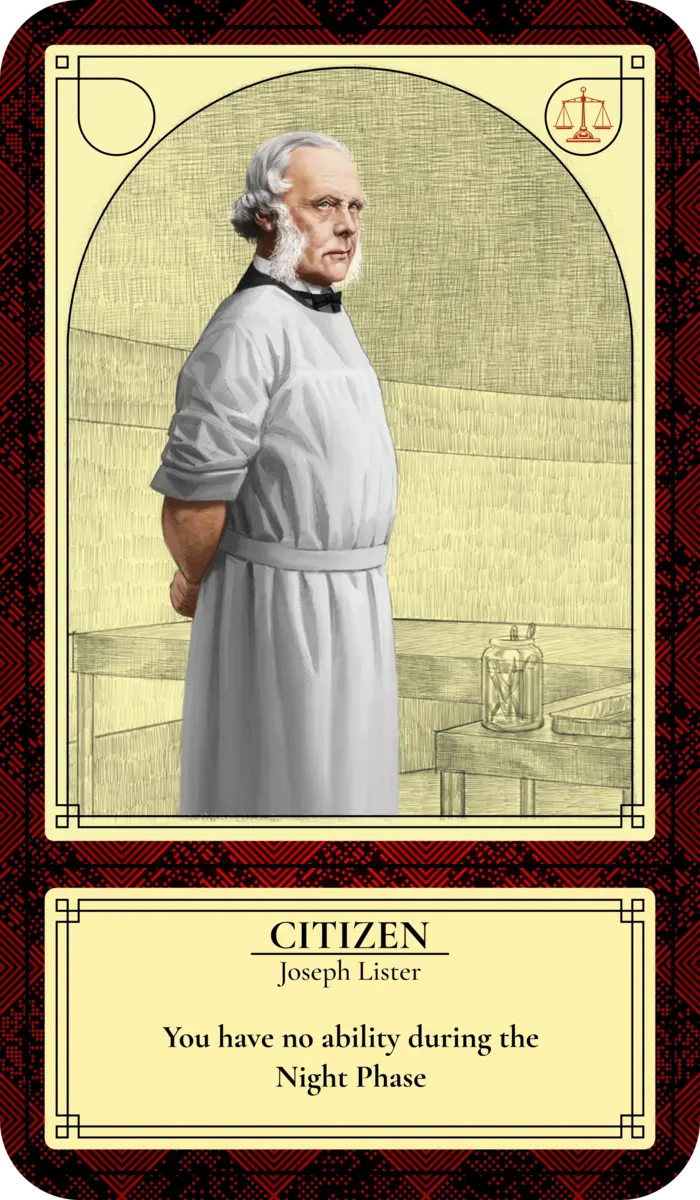
The Coroner works among the dead. Each night they choose one of the fallen and learn exactly who that person was. Joseph Lister built his life on the belief that a body will tell you what was done to it, if someone is willing to look properly. In his day, half the patients on a surgical ward died of what came after the knife, and the profession blamed bad air. Lister read a chemist's paper on fermentation, decided the rot was alive, and started soaking dressings and instruments in carbolic acid. Deaths on his ward fell from one in two to one in seven. He was disbelieved for years, because his numbers meant other surgeons had been killing their own patients. That is the Coroner: the one who looks at the dead and refuses to explain them away.
In the lore, Galton did not write to Lister as a surgeon. He wrote to him because Lister sat in the House of Lords. At some point, someone would have to stand up in a place the police could not reach, say the thing out loud, and be believed, and no man in England would be believed faster. Lister came. At the Three Harpies he had to be helped up the step, and he sat late into the night with the nurse, talking about a hospital.
“What you cannot see will still kill you. Wash your hands.”
Sir Joseph Lister
Street
In 1900 the dead still had stories, if someone would look. Mortuaries and back rooms kept what the street was not meant to see.
Meeting
This seat reads what the living cannot. One quiet look can settle an argument — or start a worse one.
The room
Say it too soon and you paint a mark on your own back. Say it too late and a vote has already gone wrong.
Inspired by
1827–1912
Somebody had to invent handwashing. That is the joke, and it is not a joke: there was a moment in history when a surgeon washing his hands before an operation rather than after it was a controversial innovation, argued about in journals, resisted by serious men. Older surgeons operated in a frock coat stiff and black with old blood, and kept it that way deliberately, because the varnish of previous patients was proof of experience. Half the people who went into a surgical ward in 1865 came out dead. Not from the knife — from what came afterwards: the wound turning, the smell, the fever, the rot. The busiest hospitals were the deadliest. The profession's explanation was bad air.
Then a surgeon in Glasgow read a French chemist's paper on fermentation, understood that the rot was made of living things rather than atmosphere, and started soaking dressings and instruments in carbolic acid — the sharp black tar derivative used for deodorising sewers. On his own accident ward, deaths after amputation dropped from roughly one in two to one in seven. He sprayed it over the operating table in a fine mist from a machine he built himself. He invented an absorbable gut ligature, so a tied blood vessel no longer needed a thread left dangling out of the body to be yanked free days later, dragging infection with it. He published the numbers. He was disbelieved for years, and the reason was simple: every measure he proposed implied that the men who had not taken it had been killing their own patients. That was exactly what it implied.
It started with a broken leg. A compound fracture — bone through the skin — was close to a death sentence then; surgeons amputated on sight rather than let it fester. Lister was a Quaker's son, raised in a house where his father ground his own lenses and made genuine improvements to the microscope, so he had grown up around the habit of looking at what other people could not see. In 1865 he dressed an eleven-year-old cart-crash victim's fracture with carbolic and left the leg on. It healed. He did it again. And again. He kept every record, and when he had eleven cases he wrote them up. He was not theorising. He was counting.
He was made a baronet, then a baron, then President of the Royal Society, and he treated Queen Victoria — he drained an abscess under the royal arm and remarked afterwards that he was the only man who had ever stuck a knife in the Queen. He died in 1912. By then the argument was over so completely that nobody remembered it had been an argument: the surgeon's own cleanliness had become the first fact in the room, before the instruments, before the diagnosis.
Forget the mortality tables and the peerage. Remember only this: he built a career on the principle that a body will tell you precisely what was done to it, if somebody is willing to look properly instead of explaining it away.
The City
Same team. Different jobs.
Mafia is easier to play than it looks. Everyone gets a hidden card — most of the table is City, a hidden few are Mafia. At night the killers quietly pick a victim while a doctor tries to guess who needs saving and a cop digs for the truth. By day the survivors argue about what happened, put someone on trial, and vote. The City wins by finding every killer; the Mafia wins by surviving until they can win a vote. The walkthrough takes you through the whole game, from the deal to the last trial.
How to play mafiaYour first game should be The Lamp and the Lancet — eight players and only three night wakes, so nobody gets lost. With a ninth chair the same deal becomes, naturally, The Ninth Chair. All twenty published deals, up to twenty-seven players, are on the setups page.
The teaching deal. Eight chairs, one lamp, one lancet — and two knives that already know each other.
City: 1 Policeman, 1 Doctor, Citizens to fill Mafia: 2 Assassins
The classic table of nine. Two killers, a cop, a doctor — and the vote does the rest.
City: 1 Policeman, 1 Doctor, Citizens to fill Mafia: 2 Assassins