What this card does
Each night you pick a player. If you die, the moderator reveals the role of your last pick.

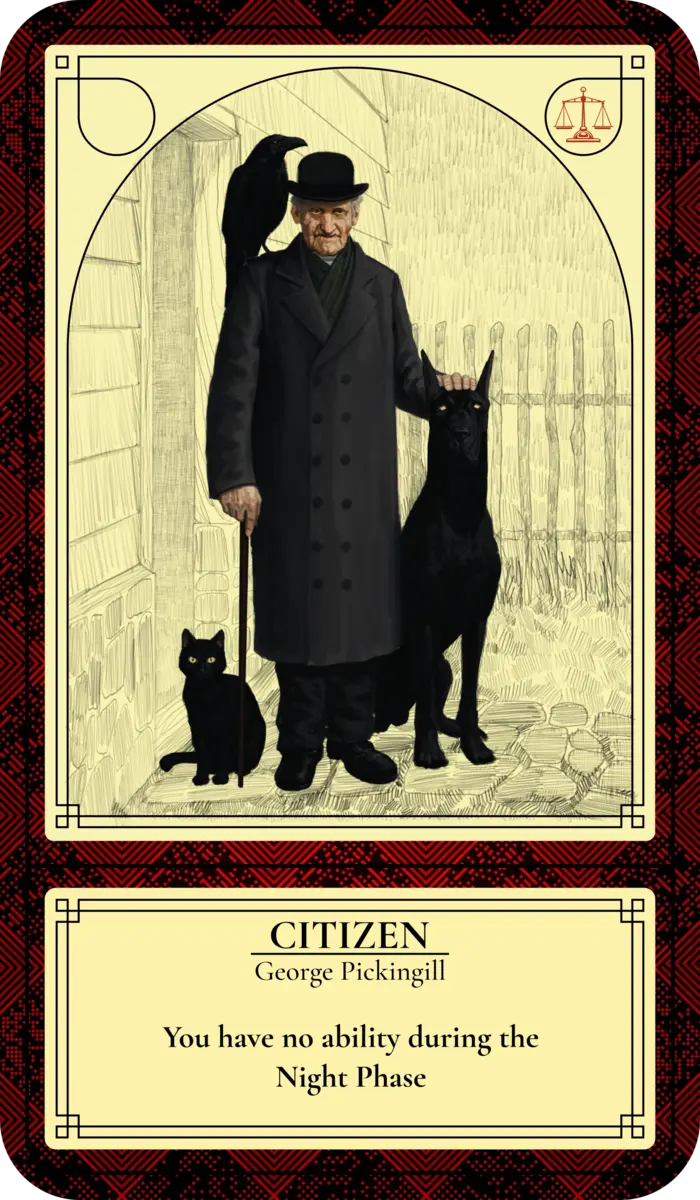
The City Night Investigate Each night
What this card does
Each night you pick a player. If you die, the moderator reveals the role of your last pick.
How to play
When the host calls the Oracle, open your eyes.
Pick a player each night.
If you die, the moderator reveals the role of your last pick.
Close your eyes. Do not talk.
Tips
The Oracle is one of the mafia roles in the mafia party game.
In the box
Published mixes that seat this card. Pick the list that fits the room, then deal.
Gunn and Henry both in chairs, and a slab for everyone else. Two checks a night — while they live.
The client cannot be summoned. The job never happened. And the house still hits back.
A soldier with two shots, and a room daring him to spend both. The Lawyer would rather nobody stood trial at all.
The Oracle dies pointing. The Vigilante has two arguments of his own. The Terrorist needs only one.
Two checks a night. One of them may still be a kindness from Sabini.
The veterans’ deal. Twenty players, three Assassins, and a day that has to keep moving.
Warzone-sized, different firm. Two Assassins, a man the Yard already cleared, and a Bishop taxing the wrong knife.
Write every wake. Call them in the same order. The quiet ones in the dark are not all done with the evening.
Every useful face in a chair. Two more chairs take the last Citizens. After that the box really is empty.
East End lore
The Oracle never says what they know. They choose someone each night, keep it to themselves, and the truth only comes out when they die. George Pickingill lived his whole life that way. He was an illiterate farm labourer in an Essex village, and for sixty years his neighbours paid him in beer to leave their harvests alone. It was said he could stop a horse dead in the road, set a plough team refusing to move, and send a black cat to run his errands. He never claimed a single power and he never denied one. The whole village organised itself around what he might know. That is the Oracle: silent while alive, and dangerous the moment he is gone.
In the lore, nobody sent for him. Galton had not written to him, and Adam Worth's people did not know his face. Yet on the one night the Three Harpies had been emptied of strangers, an old man with a black dog took the seat by the fire. A cat sat on the bench beside him as if it had paid for the place. Both sides spent the evening asking who had brought him in, and nobody could answer. Nobody moved the cat either !
“I am never early. It is everyone else who is late.”
George Pickingill
Street
East End parlours sold secrets for a few coins. People paid to hear a name they could not get any other way.
Meeting
This seat holds a name the table cannot spend yet. The story sits in one head until the room is forced to hear it.
The room
A living Oracle is a rumour. The killers would rather that rumour never harden into a fact.
Inspired by
1816–1909
He was an illiterate farm labourer in an Essex village, and for sixty years his neighbours paid him not to look at them. That was the arrangement. A man who worked the fields at Canewdon for a wage, who could not read, who owned nothing, and who was believed by everyone around him to be able to stop a horse dead in the road, blight a crop, or set a plough team refusing to move. Farmers gave him beer to leave their harvests alone. The village lived with him for the whole of his adult life and never once resolved whether the fear was justified.
The stories are specific, which is what makes them worth reading. He would stand at a hedge and the men working the field would find their tools unusable until he moved on. He was said to whistle and bring the local imps out to do his reaping in half an hour. He was credited with a black cat that ran his errands and with control over the mice in the barns. Newspapers eventually took an interest and printed him as the last of the Essex cunning men — the village practitioners who sold charms, found lost property, lifted curses, and told fortunes, and who were still working in rural England well into the industrial age. He accepted the beer. He never denied the rest.
The origin is the least mystical part of it. Canewdon in the middle of the nineteenth century was a poor parish where the difference between a good year and starvation was weather and luck, and where a labouring man had no leverage over anyone at all. A reputation was leverage. If the farmer believes you can rot his barley, he does not sack you at the end of the season, and he does not underpay you, and he does not let his sons make trouble with you. Pickingill was old, tall, unpleasant to look at by all accounts, and entirely unafraid of being disliked. He took the only power available to a man of his station and let it grow.
He died in 1909, in his nineties. Sixty years later, writers building the modern witchcraft revival adopted him wholesale and invented a career for him — secret covens, initiations, a hereditary line of nine — for which there is no evidence whatsoever and which he would not have understood. The parish record shows a labourer. The legend shows something else entirely, and the gap between the two has never been closed.
Forget the imps and the covens and the cat. Remember only this: he never claimed a single power, and an entire village organised itself around what he might know.
The City
Same team. Different jobs.
Mafia is easier to play than it looks. Everyone gets a hidden card — most of the table is City, a hidden few are Mafia. At night the killers quietly pick a victim while a doctor tries to guess who needs saving and a cop digs for the truth. By day the survivors argue about what happened, put someone on trial, and vote. The City wins by finding every killer; the Mafia wins by surviving until they can win a vote. The walkthrough takes you through the whole game, from the deal to the last trial.
How to play mafiaYour first game should be The Lamp and the Lancet — eight players and only three night wakes, so nobody gets lost. With a ninth chair the same deal becomes, naturally, The Ninth Chair. All twenty published deals, up to twenty-seven players, are on the setups page.
The teaching deal. Eight chairs, one lamp, one lancet — and two knives that already know each other.
City: 1 Policeman, 1 Doctor, Citizens to fill Mafia: 2 Assassins
The classic table of nine. Two killers, a cop, a doctor — and the vote does the rest.
City: 1 Policeman, 1 Doctor, Citizens to fill Mafia: 2 Assassins