What this card does
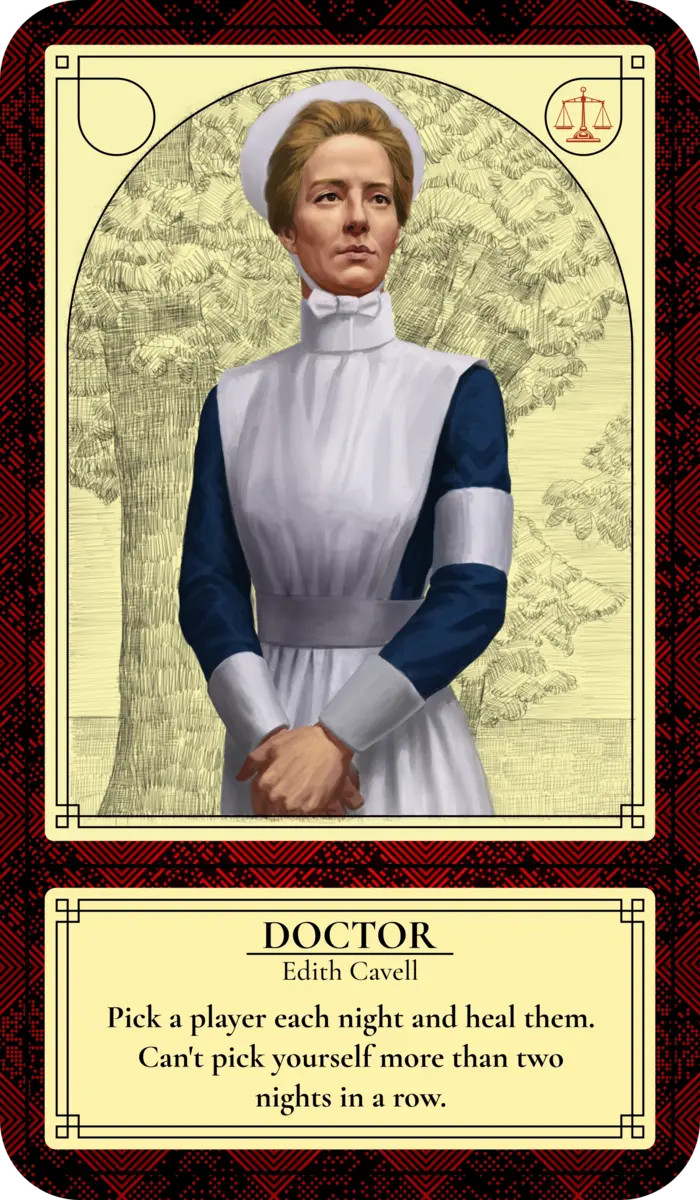
Each night you pick a player and heal them. You cannot pick yourself two nights in a row.

The City Night Heal Each night
What this card does
Each night you pick a player and heal them. You cannot pick yourself two nights in a row.
How to play
When the host calls the Doctor, open your eyes.
Pick a player each night and heal them. Can't pick yourself two nights in a row.
Close your eyes. Do not say who you healed.
Tips
The Doctor is one of the mafia roles in the mafia party game.
In the box
Published mixes that seat this card. Pick the list that fits the room, then deal.
When only six friends could make it, you still light the lamp and put the lancet on the table. One knife is plenty in a room this close.
Someone found a seventh chair in the hall and the evening grew a little kinder. Same one knife, one more neighbour to talk to.
The teaching deal. Eight chairs, one lamp, one lancet — and two knives that already know each other.
Still one lamp — but now one door hits back. Call on the wrong house at night and you will wish you had sent a note.
The classic table of nine. Two killers, a cop, a doctor — and the vote does the rest.
One lamp, and it can be lied to. The Yard filed him under City, and the Yard is never wrong.
She points first, and somebody’s night simply does not happen. And the man at the door duels his callers.
The Bishop taxes the Assassins’ knife. The Terrorist’s exit does not go through the parish.
Gunn and Henry both in chairs, and a slab for everyone else. Two checks a night — while they live.
The client cannot be summoned. The job never happened. And the house still hits back.
Built for rooms that love to argue. Words win this deal — and careless words lose it.
A soldier with two shots, and a room daring him to spend both. The Lawyer would rather nobody stood trial at all.
Minutes are read at the end of the evening — and some names have been made unavailable.
The Oracle dies pointing. The Vigilante has two arguments of his own. The Terrorist needs only one.
Two checks a night. One of them may still be a kindness from Sabini.
The veterans’ deal. Twenty players, three Assassins, and a day that has to keep moving.
Warzone-sized, different firm. Two Assassins, a man the Yard already cleared, and a Bishop taxing the wrong knife.
Write every wake. Call them in the same order. The quiet ones in the dark are not all done with the evening.
Every useful face in a chair. Two more chairs take the last Citizens. After that the box really is empty.
East End lore
The Doctor chooses one person each night and keeps them alive, and cannot save herself two nights running. Edith Cavell lived by that rule. She ran a nurses' training school in occupied Brussels, and while enemy officers walked her corridors she hid around two hundred Allied soldiers in her wards and cellar and passed them down the line to safety. She nursed the enemy's wounded to the same standard, which made her the last person anyone thought to search. When she was caught she admitted everything, asked for no mercy, and was shot at dawn. The night before, she said she must hold no hatred for anyone. That is the Doctor: she saves whoever is in front of her and never once thinks to save herself.
In the lore, it was Joseph Bell who named her. He told Galton that they had left out the most useful person in the whole arrangement: a nurse. A nurse is let into any house in any district at any hour without a question, and then left alone with whoever is ill and whoever is frightened. Bell called her the most literal-minded woman he had ever met, and meant it as praise. She wrote back with four questions about exactly what would be expected of her, then agreed. At the Three Harpies she sat very straight, with no drink in front of her.
“I don't choose sides. I choose whoever is left on the floor.”
Edith Louisa Cavell
Street
Night nurses and surgeons kept people alive in rooms that should have killed them. The East End knew that kind of care.
Meeting
The table sleeps better if it believes someone is covering a body. That belief can be as useful as the cover itself.
The room
Save the wrong chair and you look dirty. Save the right one and nobody can thank you out loud.
Inspired by
1865–1915
Some heroes carry rifles. This one carried a bedpan, wore a starched apron, and cost the German army more men than a regiment could have. Edith Cavell ran a nurses' training school in occupied Brussels, and while German officers walked her corridors daily she was moving Allied soldiers out of the country — roughly two hundred of them, hidden in her wards and her cellar, fed, papered, and handed down the line to the Dutch border. She was arrested, held in solitary for ten weeks, tried, and shot at dawn on 12 October 1915. She was forty-nine years old. Enlistment in Britain surged in the weeks that followed. They killed a nurse and armed a generation.
She never denied a word of it. At trial she admitted everything, plainly and without theatre, and said the men would have been shot had she not helped them. She offered no defence worth the name and asked for no mercy. What made it work for nine months was the thing they could not imagine being a weapon: she treated German wounded in the same wards, to the same standard, with the same care — which made her the last person in Brussels anyone thought to search. Her competence was the cover. Her decency was the cover. The night before they shot her, she told an English chaplain that patriotism was not enough, and that she must hold no hatred or bitterness towards anyone. She said that about the men who were going to kill her in the morning, and she meant it.
She was not born to any of this. A Norfolk vicar's daughter, she spent her twenties as a governess and did not begin nursing until she was thirty, training at the London Hospital on the Whitechapel Road — the East End, the worst wards in the country, the hardest apprenticeship available to anyone. She went to the typhoid outbreak at Maidstone, where nursing was the whole of the treatment and the dying were counted daily. She never went back to minding other people's children. Then Belgium called her over to build modern nursing in a country that had none, and she built it from nothing: the school, the standards, the profession itself.
After the war they brought her home in state. Her body went through London to Westminster Abbey and was buried at Norwich Cathedral. Her statue stands by Trafalgar Square with her last sentence carved into the stone. A mountain in Canada bears her name.
Forget the two hundred men and the firing squad. Remember only this: she saved whoever was in front of her, without exception and without asking, and she never once thought to save herself.
The City
Same team. Different jobs.
Mafia is easier to play than it looks. Everyone gets a hidden card — most of the table is City, a hidden few are Mafia. At night the killers quietly pick a victim while a doctor tries to guess who needs saving and a cop digs for the truth. By day the survivors argue about what happened, put someone on trial, and vote. The City wins by finding every killer; the Mafia wins by surviving until they can win a vote. The walkthrough takes you through the whole game, from the deal to the last trial.
How to play mafiaYour first game should be The Lamp and the Lancet — eight players and only three night wakes, so nobody gets lost. With a ninth chair the same deal becomes, naturally, The Ninth Chair. All twenty published deals, up to twenty-seven players, are on the setups page.
The teaching deal. Eight chairs, one lamp, one lancet — and two knives that already know each other.
City: 1 Policeman, 1 Doctor, Citizens to fill Mafia: 2 Assassins
The classic table of nine. Two killers, a cop, a doctor — and the vote does the rest.
City: 1 Policeman, 1 Doctor, Citizens to fill Mafia: 2 Assassins