What this card does
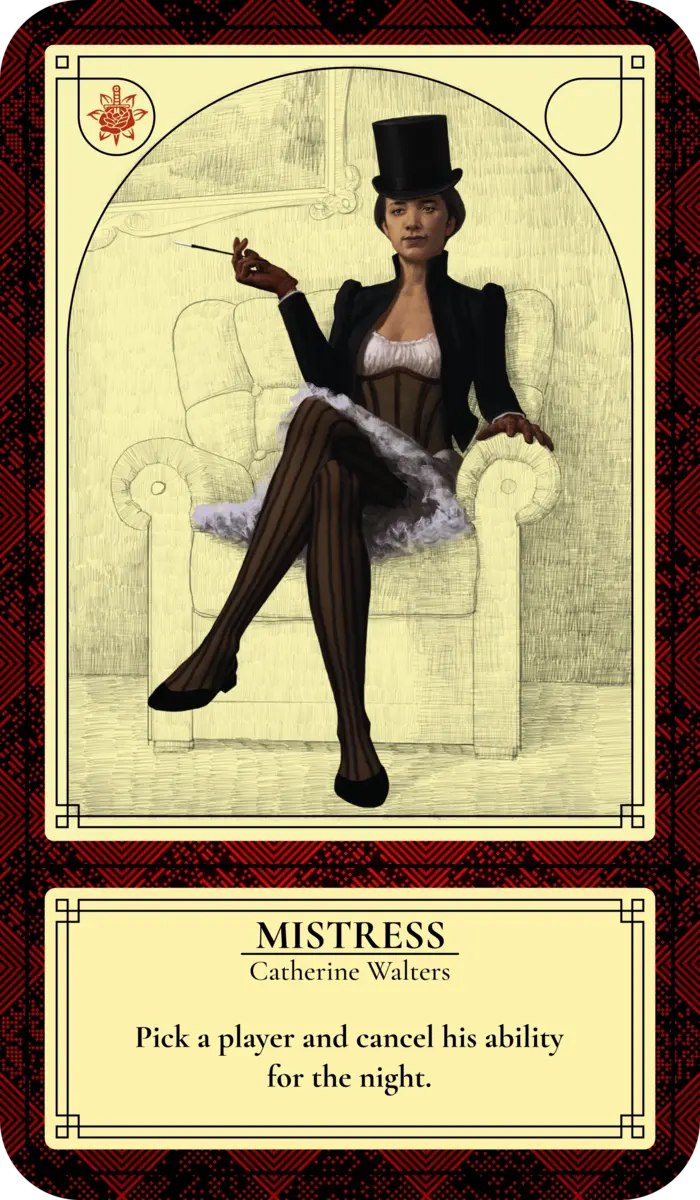
Each night you pick a player and cancel their ability for the night.

The Mafia Expansion Night Block Each night
What this card does
Each night you pick a player and cancel their ability for the night.
How to play
When this card is in the deal, the host calls you first.
Pick a player each night and cancel their ability for the night.
Close your eyes. That player’s night job does not happen.
Tips
The Mistress is one of the mafia roles in the mafia party game.
In the box
Published mixes that seat this card. Pick the list that fits the room, then deal.
She points first, and somebody’s night simply does not happen. And the man at the door duels his callers.
One seat raises the recently dead. One seat burns them off the roll. And the lamp may be lying.
The City gets tools, the Mafia gets tricks. You win this one as a table, not as four solo stars.
The client cannot be summoned. The job never happened. And the house still hits back.
Built for rooms that love to argue. Words win this deal — and careless words lose it.
Minutes are read at the end of the evening — and some names have been made unavailable.
Two checks a night. One of them may still be a kindness from Sabini.
The veterans’ deal. Twenty players, three Assassins, and a day that has to keep moving.
Warzone-sized, different firm. Two Assassins, a man the Yard already cleared, and a Bishop taxing the wrong knife.
Write every wake. Call them in the same order. The quiet ones in the dark are not all done with the evening.
Every useful face in a chair. Two more chairs take the last Citizens. After that the box really is empty.
East End lore
The Mistress kills no one. She chooses a player each night, and for that night their ability simply does not happen. Catherine Walters, known as Skittles, was a Liverpool dockworker's daughter who became the most talked-about woman in London after the Queen. When she rode in Hyde Park, the crowds grew so large that the authorities asked her to stop. Among her admirers were a future king, a future prime minister, a Chancellor of the Exchequer and the general commanding the British Army. They talked in front of her because talking to her was the pleasure they were paying for, and not one of them wondered what she did with what she heard. She never married, never needed to, and died in her own house in Mayfair with money. That is the Mistress: whoever she chooses is too occupied that night to do anything at all.
In the lore, her name is in nobody's account. Adam Worth described everyone he saw in that house, the old man by the fire and the woman with the cards among them, and she is not there. Galton's letters do not mention her. If she was anywhere near the Three Harpies, she managed it the way she managed everything else: every man in the room was looking somewhere else.
“Every man tells me everything eventually. The trick is being in the room when he does.”
Catherine Walters
Street
A smile that made men miss the knife. In 1900, the East End understood that kind of power without needing a uniform.
Meeting
Some nights never start. Someone at the table is in the business of that — a cancelled hour the City cannot spend.
The room
The City’s night tools are only as good as the night they are allowed to have. This seat is why that is not a given.
Inspired by
1839–1920
A Liverpool dockworker's daughter stopped the traffic in Hyde Park, and the government asked her to stop doing it. That is not a figure of speech. When Catherine Walters rode in Rotten Row, the crowds that gathered to watch became so large and so unmanageable that the authorities made an approach. She was a courtesan — an unmarried woman kept by wealthy men, entirely outside respectable society and entirely central to it — and at her height she was the most photographed and most discussed woman in London who was not the Queen. She never married. She never had to. She died at eighty, in her own house in Mayfair, with money.
She held it by knowing things. Her clients and admirers included a future Prime Minister, a future King of England, the Chancellor of the Exchequer, a Prime Minister's son, and the general who commanded the British Army — men who talked in front of her because talking to her was the pleasure they were paying for, and who assumed a woman in her position had no forwarding address for what she heard. She rode superbly, which was the currency of that world, and dressed so precisely that a habit cut for her set a fashion across Europe. She was witty and blunt and did not pretend to be respectable, which meant nobody could threaten her with exposure. She was called Skittles, after the bowling alley she was said to have worked in. She kept the name for sixty years and never bothered to correct any of the stories.
She came off the Liverpool waterfront. Her father worked as a customs officer on the docks; the family was poor and Irish-descended and there were several children, and her mother died when she was young. She went into the only trade available to a spectacularly good-looking girl with no money and no protection, and she made a series of cold, accurate decisions about which men were worth her time. The first was a Lancashire aristocrat. The last was an entire generation of the British establishment.
She outlived the era completely. She stayed at South Street, Mayfair, through the end of the century, receiving visitors long after the men who had made her famous were dead — including a young Wilfrid Scawen Blunt who had loved her decades earlier and kept coming back. She died in 1920, in a London that no longer had a category for what she had been.
Forget the horses and the dresses and the crowds in the Row. Remember only this: half the men running the country said things in front of her that they would not have said in front of each other, and not one of them ever thought to wonder what she did with it.
The Mafia
Same team. Different jobs.
Mafia is easier to play than it looks. Everyone gets a hidden card — most of the table is City, a hidden few are Mafia. At night the killers quietly pick a victim while a doctor tries to guess who needs saving and a cop digs for the truth. By day the survivors argue about what happened, put someone on trial, and vote. The City wins by finding every killer; the Mafia wins by surviving until they can win a vote. The walkthrough takes you through the whole game, from the deal to the last trial.
How to play mafiaYour first game should be The Lamp and the Lancet — eight players and only three night wakes, so nobody gets lost. With a ninth chair the same deal becomes, naturally, The Ninth Chair. All twenty published deals, up to twenty-seven players, are on the setups page.
The teaching deal. Eight chairs, one lamp, one lancet — and two knives that already know each other.
City: 1 Policeman, 1 Doctor, Citizens to fill Mafia: 2 Assassins
The classic table of nine. Two killers, a cop, a doctor — and the vote does the rest.
City: 1 Policeman, 1 Doctor, Citizens to fill Mafia: 2 Assassins