What this card does
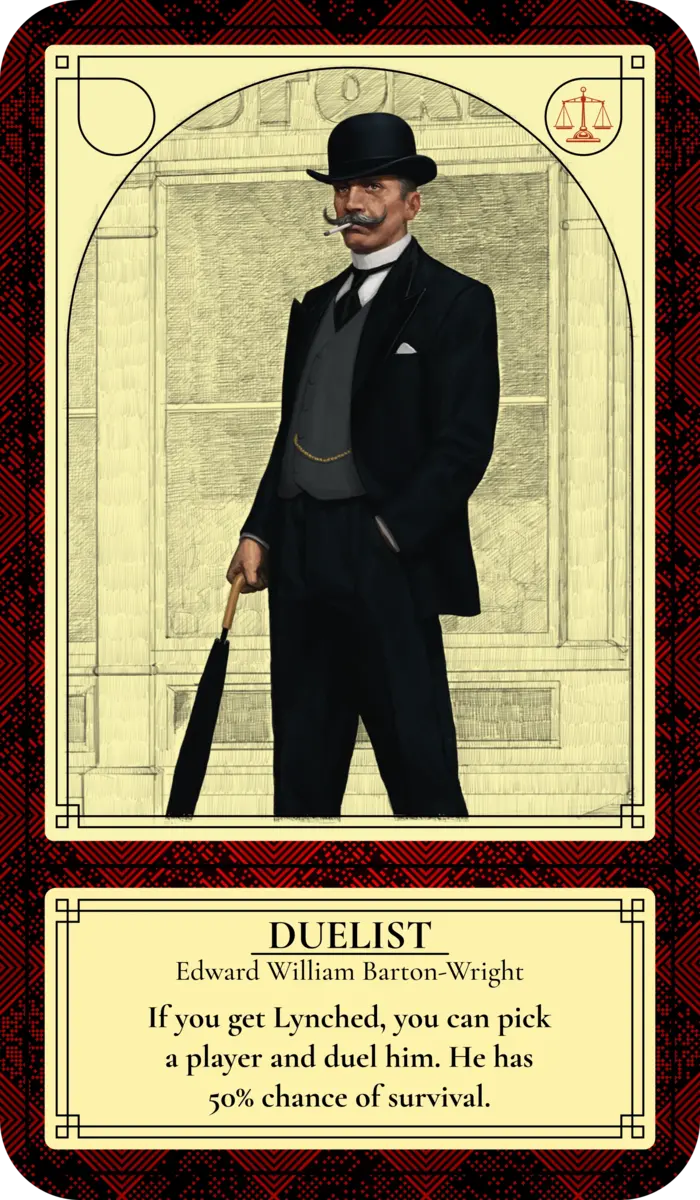
Duel any enemy who visits you at night. If you are lynched, night falls and you duel one of your voters.

The City Expansion Always on Kill
What this card does
Duel any enemy who visits you at night. If you are lynched, night falls and you duel one of your voters.
How to play
Duel any enemy who visits you at night. You do not wake for this. The host applies it.
If lynched, night falls and you duel one of your voters.
Keep the card hidden until the host has to resolve a duel.
Tips
The Duelist is one of the mafia roles in the mafia party game.
In the box
Published mixes that seat this card. Pick the list that fits the room, then deal.
Still one lamp — but now one door hits back. Call on the wrong house at night and you will wish you had sent a note.
For tables that like clues. Read the dead, check a team, and mind the Duelist’s duel.
She points first, and somebody’s night simply does not happen. And the man at the door duels his callers.
The City gets tools, the Mafia gets tricks. You win this one as a table, not as four solo stars.
The client cannot be summoned. The job never happened. And the house still hits back.
Built for rooms that love to argue. Words win this deal — and careless words lose it.
Minutes are read at the end of the evening — and some names have been made unavailable.
The Oracle dies pointing. The Vigilante has two arguments of his own. The Terrorist needs only one.
Two checks a night. One of them may still be a kindness from Sabini.
The veterans’ deal. Twenty players, three Assassins, and a day that has to keep moving.
Warzone-sized, different firm. Two Assassins, a man the Yard already cleared, and a Bishop taxing the wrong knife.
Write every wake. Call them in the same order. The quiet ones in the dark are not all done with the evening.
Every useful face in a chair. Two more chairs take the last Citizens. After that the box really is empty.
East End lore
Come for the Duelist at night and you will have to fight him. Put him to the vote and, before the day ends, he will turn on one of the hands that condemned him. Edward Barton-Wright invented mixed martial arts before anyone had a name for it. He combined jiu-jitsu, boxing, French kicking and the fighting cane into a single system, named it Bartitsu after himself, and opened a club in Soho to teach gentlemen how to survive being attacked in the street. He brought some of the first Japanese instructors ever to teach in the West, and let London watch small men throw large ones. It is his art, misspelled, that Sherlock Holmes uses to survive the Reichenbach Falls. That is the Duelist: a man who never assumed the bigger man was the safer bet, and who prepared for the fight before it found him.
In the lore, nobody has said who sent him, and nobody has said he was there. But a sober lighterman swears that on the morning the Three Harpies went up, he watched an English gentleman in a good coat fight eight or nine men in the road at once, and beat them. He used a walking stick, then a pocket handkerchief, and at the end a sword drawn from an umbrella. The lighterman said the gentleman was never once hurried, and that it looked like a dance.
“Manners are the first technique. Everything after is follow-through.”
Eduard Barton Wright
Street
Bartitsu gyms and night streets. A person who answers a visit with a fight, and does not need to go looking.
Meeting
This seat does not chase. It waits. In a mafia card game, some jobs only happen when someone else knocks.
The room
Vote this card out and the argument may not be over. The table learns that the hard way.
Inspired by
1860–1951
He invented mixed martial arts in 1898 and named it after himself. Bartitsu — his surname spliced with jiu-jitsu — was the first system in recorded history to deliberately combine an Asian grappling art with European fighting methods and teach them as one discipline, and he did it a century before anyone else thought it was a good idea. He put jiu-jitsu, boxing, French savate kicking, and cane fighting into a single curriculum. He opened a club in Soho with electric-light therapy and heated rooms, imported Japanese instructors to London — some of the first ever to teach in the West — and advertised the whole thing to gentlemen who might reasonably expect to be attacked in the street. He is why Sherlock Holmes survives the Reichenbach Falls. Conan Doyle wrote that Holmes defeated Moriarty using "baritsu," having misspelled the name of a real system he had read about in the papers.
He proved it in public. He staged challenge matches, put his Japanese instructors up against English wrestlers and boxers of far greater size, and let London watch small men fold large ones. He wrote instructional articles with photographs, laying out how to break a wrist, throw a man who has seized your lapel, and use a walking stick as a weapon at the correct distance — practical, unromantic, aimed squarely at a city where a well-dressed man walking home at night was a target. He recruited Yukio Tani and Sadakazu Uyenishi, teenagers who became the first professional jiu-jitsu men in Britain, and Pierre Vigny, a Swiss master of the cane. The Bartitsu Club taught women as well as men, and the suffragette movement later took the training and used it against the police.
He came to it as an engineer. He was born in India to an English family, educated in Germany and France, and worked as an antimony miner, surveyor, and railway engineer across three continents, which meant a life spent among men who settled things physically in places with no law worth appealing to. He spent three years in Japan working for a cement company and trained there in jiu-jitsu. He came home to London convinced that everything the English knew about self-defence was theatre, and that the only question worth asking about a fighting method is whether it works on a man who is bigger than you.
The club closed within about three years. It was expensive, the instructors left to make more money teaching on their own, and the fashion moved on. He spent the rest of his life running unsuccessful electrotherapy clinics and died in 1951, in his nineties, and was buried in an unmarked grave. His system was forgotten for eighty years and then rediscovered whole, from his own published articles.
Forget the club and the Holmes footnote and the unmarked grave. Remember only this: he built his entire life around the conviction that a fight is settled by whoever prepared for it correctly — and he never assumed the bigger man was the safer bet.
The City
Same team. Different jobs.
Mafia is easier to play than it looks. Everyone gets a hidden card — most of the table is City, a hidden few are Mafia. At night the killers quietly pick a victim while a doctor tries to guess who needs saving and a cop digs for the truth. By day the survivors argue about what happened, put someone on trial, and vote. The City wins by finding every killer; the Mafia wins by surviving until they can win a vote. The walkthrough takes you through the whole game, from the deal to the last trial.
How to play mafiaYour first game should be The Lamp and the Lancet — eight players and only three night wakes, so nobody gets lost. With a ninth chair the same deal becomes, naturally, The Ninth Chair. All twenty published deals, up to twenty-seven players, are on the setups page.
The teaching deal. Eight chairs, one lamp, one lancet — and two knives that already know each other.
City: 1 Policeman, 1 Doctor, Citizens to fill Mafia: 2 Assassins
The classic table of nine. Two killers, a cop, a doctor — and the vote does the rest.
City: 1 Policeman, 1 Doctor, Citizens to fill Mafia: 2 Assassins