What this card does
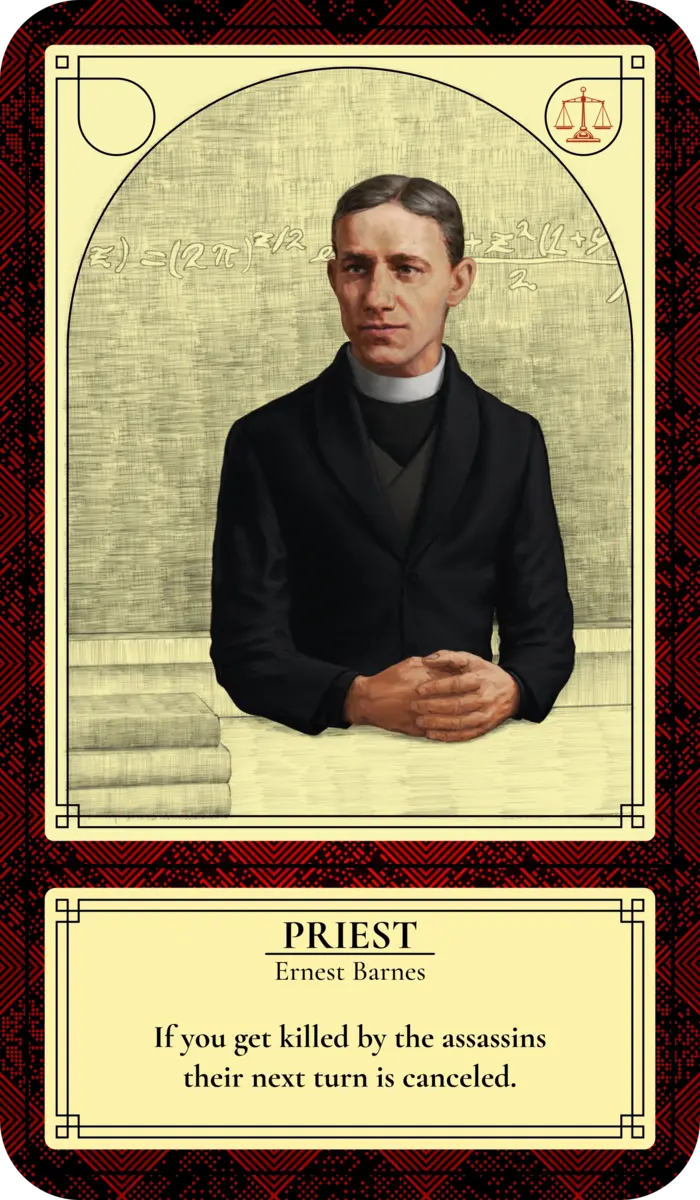
You do not pick at night. If the assassins kill you, their next turn is canceled.

The City Always on Once
What this card does
You do not pick at night. If the assassins kill you, their next turn is canceled.
How to play
You do not wake. You do not pick a player.
If killed by the assassins, their next turn is canceled.
Keep the card hidden. A vote is not the same as an assassin kill.
Tips
The Priest is one of the mafia roles in the mafia party game.
In the box
Published mixes that seat this card. Pick the list that fits the room, then deal.
The Bishop taxes the Assassins’ knife. The Terrorist’s exit does not go through the parish.
The City gets tools, the Mafia gets tricks. You win this one as a table, not as four solo stars.
Built for rooms that love to argue. Words win this deal — and careless words lose it.
Minutes are read at the end of the evening — and some names have been made unavailable.
Warzone-sized, different firm. Two Assassins, a man the Yard already cleared, and a Bishop taxing the wrong knife.
Write every wake. Call them in the same order. The quiet ones in the dark are not all done with the evening.
Every useful face in a chair. Two more chairs take the last Citizens. After that the box really is empty.
East End lore
Kill the Priest, and it costs the killers their next move. Ernest Barnes was a man who could not be removed cheaply. He was a bishop of the Church of England who did not believe in miracles, and he said so from his own cathedral pulpit for twenty-nine years. He preached that Darwin was right. He stayed a pacifist through two world wars, when that was close to treason. His own clergy refused to receive him, and the Archbishop of Canterbury rebuked him in the House of Lords. He resigned nothing, withdrew nothing, and outlasted every one of them. That is the Priest: whoever moves against him will pay for it.
In the lore, Galton wrote to him because Barnes was two useful men in one. As a clergyman he would hear things in a vestry that no constable ever would. As a Cambridge mathematician, he could sit down with the tonnage returns of four wharves and find the discrepancy. Galton said it was a combination he liked and did not altogether trust. At the Three Harpies, Barnes was the first to ask who the old man by the fire was, and nobody could tell him.
“Show me what Darwin was afraid of. A man's fears are more honest than his books.”
Bishop Ernest William Barnes
Street
The kind of man the street still stood up for, even when it did not go to church. A soft face can be a hard cost.
Meeting
This seat is a trap the killers may walk into. The table may never know until the night after it happens.
The room
People will want this card to save them. It is not a hero. It is a price the Mafia may refuse to pay.
Inspired by
1874–1953
He was a bishop of the Church of England who did not believe in miracles, and he said so from the pulpit of his own cathedral. Not in private, not in a journal read by four men — in Birmingham, to his own diocese, repeatedly, for twenty-nine years. He rejected the physical resurrection of the body. He denied that the bread and wine of communion become anything at all. He preached that Darwin was correct and that Genesis was not history, at a time when much of his church was still negotiating with that idea. Clergy under his authority refused to receive him. The Archbishop of Canterbury publicly rebuked him in the House of Lords. The Convocation of Canterbury moved against him. He did not resign, and he did not stop.
The nickname was "the Gorilla Bishop," and it was not affectionate. He gave sermons on human evolution in Westminster Abbey that made national newspapers. He described the elaborate ritual practices of the High Church wing as magic and superstition, and refused to license priests who taught them, which meant a running civil war inside his own diocese for three decades. He was a pacifist — through the First World War, when that was near-treasonous, and through the Second, when it was worse, and he opposed the atomic bomb from the moment it existed. He wrote a book in his seventies arguing that the historical Jesus could not be reconstructed from the Gospels and that the miraculous elements were later accretions. His own bishops asked him to withdraw it or resign. He withdrew nothing, resigned nothing, and simply outlasted them.
None of it came from doubt. It came from mathematics. Before he was a clergyman he was a Cambridge mathematician — a Fellow of Trinity, a Fellow of the Royal Society, elected for original work on the theory of functions, with a mathematical function still named after him. He was trained to accept a proof and discard everything that failed one, and he was raised a Nonconformist teacher's son who had never learned to treat institutional authority as an argument. When he took orders he did not put the method down. He applied it to scripture and reported the results, and he could never afterwards understand why anyone found the procedure shocking.
He held Birmingham until 1953 and died a few months after retiring. The men who tried to remove him failed at every attempt. Most of what he was denounced for is now unremarkable in the Church that denounced him.
Forget the heresy trials and the rebukes and the thirty-year war. Remember only this: he stood between his people and the crowd that wanted them corrected, alone, in public, for a working lifetime — and no one ever moved him off the spot.
The City
Same team. Different jobs.
Mafia is easier to play than it looks. Everyone gets a hidden card — most of the table is City, a hidden few are Mafia. At night the killers quietly pick a victim while a doctor tries to guess who needs saving and a cop digs for the truth. By day the survivors argue about what happened, put someone on trial, and vote. The City wins by finding every killer; the Mafia wins by surviving until they can win a vote. The walkthrough takes you through the whole game, from the deal to the last trial.
How to play mafiaYour first game should be The Lamp and the Lancet — eight players and only three night wakes, so nobody gets lost. With a ninth chair the same deal becomes, naturally, The Ninth Chair. All twenty published deals, up to twenty-seven players, are on the setups page.
The teaching deal. Eight chairs, one lamp, one lancet — and two knives that already know each other.
City: 1 Policeman, 1 Doctor, Citizens to fill Mafia: 2 Assassins
The classic table of nine. Two killers, a cop, a doctor — and the vote does the rest.
City: 1 Policeman, 1 Doctor, Citizens to fill Mafia: 2 Assassins