What this card does
Each night you pick a dead player and burn them. They cannot vote at the Final Witness.

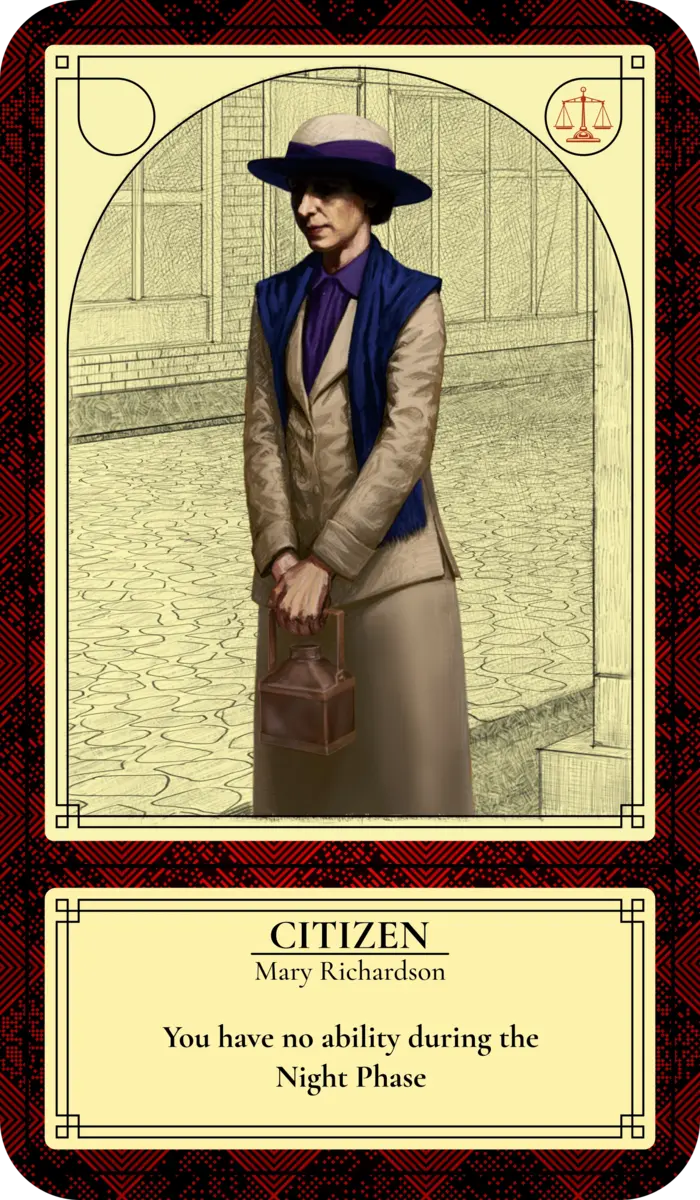
The Mafia Expansion Night Block Each night
What this card does
Each night you pick a dead player and burn them. They cannot vote at the Final Witness.
How to play
When the host calls the Arsonist, open your eyes.
Each night, pick a dead player and burn them; they cannot vote at the Final Witness.
Close your eyes. If nobody is dead yet, you have no pick.
Tips
The Arsonist is one of the mafia roles in the mafia party game.
In the box
Published mixes that seat this card. Pick the list that fits the room, then deal.
One seat raises the recently dead. One seat burns them off the roll. And the lamp may be lying.
The City gets tools, the Mafia gets tricks. You win this one as a table, not as four solo stars.
Minutes are read at the end of the evening — and some names have been made unavailable.
The veterans’ deal. Twenty players, three Assassins, and a day that has to keep moving.
Write every wake. Call them in the same order. The quiet ones in the dark are not all done with the evening.
Every useful face in a chair. Two more chairs take the last Citizens. After that the box really is empty.
East End lore
The Arsonist works on the dead. Each night she burns one of the fallen, and at the Final Witness their voice is gone. Mary Richardson understood that the quickest way to be heard is to destroy what people have been told is priceless. She once walked into the National Gallery with a meat cleaver hidden in her sleeve and struck the most famous nude in Britain seven times before the guards pulled her away. She burned a country house to the ground, bombed a railway station, smashed windows, and was arrested nine times and force-fed through a tube again and again. She walked back out and did it again. That is the Arsonist: she takes away what the other side was counting on, and she never looks away while it burns.
In the lore, nobody has said who brought her, or whose side she was on, or whether there were sides left by then. Adam Worth lay in the road watching the Three Harpies burn. At the edge of the bar, where the boards still held, a pile of bodies was alight, and a woman was dragging more of them towards it. She was not pulling anyone clear. She was taking them to the fire, steadily, with her sleeves rolled up. She was on her third or fourth when he lost sight of her.
“I don't burn houses. I burn the certainty of the men who live in them.”
Mary Richardson
Street
A burned room was a warning the whole street could read. In this mafia card game, fire is still a way to steal a voice.
Meeting
The dead still get a say at the end of The Final Witness. This seat is trying to take that say away.
The room
Burning a corpse is not a kill. The living still have to notice what is missing when the last vote comes.
Inspired by
1889–1961
She walked into the National Gallery on a Tuesday morning with a meat cleaver hidden in her sleeve and destroyed the most famous nude painting in Britain. Velázquez's Rokeby Venus — bought for the nation four years earlier at enormous public expense — hung in a room with a guard on the door. She stood in front of it, waited, and when the guard's attention moved she struck the canvas seven times before she was pulled off it. She gave her reason immediately and in writing: the government was destroying Emmeline Pankhurst, the most beautiful character in modern history, and she had destroyed the picture of the most beautiful woman in mythology. The gallery closed. Every museum in London reviewed who it let through the door. She was thirty.
That was one morning of a campaign. She burned a country house near Hampton Court to the ground. She bombed a railway station. She smashed windows. She was arrested nine times, sentenced to more than three years in total, and force-fed repeatedly — held down while a tube was forced into her, hundreds of times across her imprisonments — and released and re-arrested under the law that let the Home Office do exactly that. She was also, on one occasion, run over. She kept going. The point of the campaign was never property in itself; it was that a state which valued a canvas more than a woman should be made to prove it in public, and every fire and every broken window forced the demonstration again.
She came from Canada and arrived at it sideways. Born in Ontario, raised partly in Italy, she came to London young and was working as a journalist, unattached to any cause, when she saw a suffragette procession and followed it. What settled it was not theory: it was Black Friday in 1910, when women marching on Parliament were beaten and assaulted by police in the street for six hours while nobody intervened. After that she stopped believing that being reasonable was a strategy.
Afterwards, the record turns strange. She stood for Parliament three times for Labour and lost. She wrote poetry and a memoir. Then in the 1930s she joined the British Union of Fascists and became head of its women's section, before leaving it a few years later. She died in Hastings in 1961, largely forgotten, and is remembered almost entirely for eleven seconds in front of a painting.
Forget the cleaver and the fires and the nine arrests. Remember only this: she understood that the fastest way to be heard is to destroy the thing they said was priceless — and she never once destroyed anything that could bleed.
The Mafia
Same team. Different jobs.
Mafia is easier to play than it looks. Everyone gets a hidden card — most of the table is City, a hidden few are Mafia. At night the killers quietly pick a victim while a doctor tries to guess who needs saving and a cop digs for the truth. By day the survivors argue about what happened, put someone on trial, and vote. The City wins by finding every killer; the Mafia wins by surviving until they can win a vote. The walkthrough takes you through the whole game, from the deal to the last trial.
How to play mafiaYour first game should be The Lamp and the Lancet — eight players and only three night wakes, so nobody gets lost. With a ninth chair the same deal becomes, naturally, The Ninth Chair. All twenty published deals, up to twenty-seven players, are on the setups page.
The teaching deal. Eight chairs, one lamp, one lancet — and two knives that already know each other.
City: 1 Policeman, 1 Doctor, Citizens to fill Mafia: 2 Assassins
The classic table of nine. Two killers, a cop, a doctor — and the vote does the rest.
City: 1 Policeman, 1 Doctor, Citizens to fill Mafia: 2 Assassins