What this card does
Twice per game you pick a player and kill them.

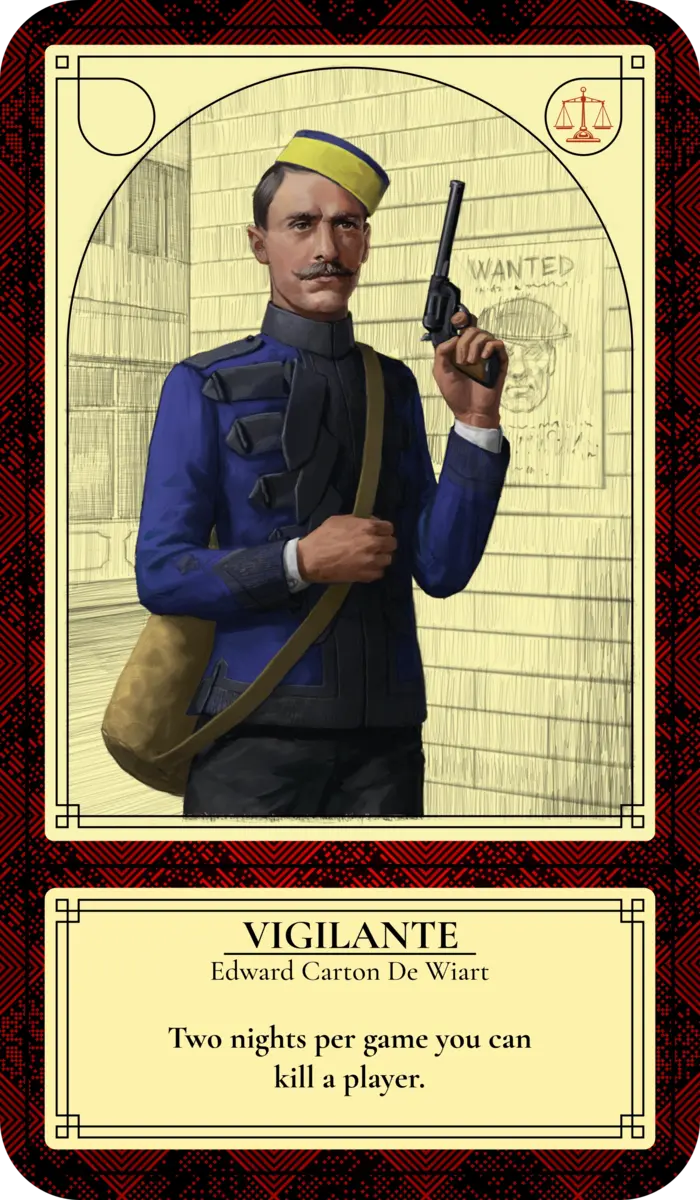
The City Night Kill Twice per game
What this card does
Twice per game you pick a player and kill them.
How to play
When the host calls the Vigilante, open your eyes.
Twice per game, pick a player and kill them.
Close your eyes. You do not have to use it every night. You have two uses in the whole game.
Tips
The Vigilante is one of the mafia roles in the mafia party game.
In the box
Published mixes that seat this card. Pick the list that fits the room, then deal.
A soldier with two shots, and a room daring him to spend both. The Lawyer would rather nobody stood trial at all.
The Oracle dies pointing. The Vigilante has two arguments of his own. The Terrorist needs only one.
The veterans’ deal. Twenty players, three Assassins, and a day that has to keep moving.
Warzone-sized, different firm. Two Assassins, a man the Yard already cleared, and a Bishop taxing the wrong knife.
Write every wake. Call them in the same order. The quiet ones in the dark are not all done with the evening.
Every useful face in a chair. Two more chairs take the last Citizens. After that the box really is empty.
East End lore
Twice a game, the Vigilante decides someone will not see morning, with no trial and no vote. Adrian Carton de Wiart settled things the same way. He walked out of Oxford, enlisted under a false name and a false age, and spent the rest of his life at war. He lost an eye and part of an ear. When a surgeon refused to take off his ruined fingers, he pulled them off himself. He won Britain's highest award for valour holding a position with one hand, pulling the grenade pins with his teeth. He was shot through the skull, the hip, the leg and the ankle, and he wrote afterwards that he had thoroughly enjoyed it. That is the Vigilante: a man who treats his own life as ammunition and spends it without asking for change.
In the lore, Galton came to the hospital for Joseph Bell and left with a soldier. Carton de Wiart was lying in a ward with a hole in him, complaining loudly that they would not send him back. Galton told him more than he meant to. The young man never asked whether it was true. He asked where, and when, and then asked for four pounds for a revolver. Galton gave him five. He was the first to arrive, and on the morning the shooting started, he went down the cellar stair towards the screaming instead of out the open door beside him. He has not repaid the five pounds.
“They told me I was too young for war. War disagreed.”
Sir Adrian Carton de Wiart
Street
Some people stop waiting for the vote. In 1900 that looked like courage. It also looked like a second killer.
Meeting
The City has a gun of its own, and that scares the City too. This seat is watched from both halves of the table.
The room
Point at the wrong chair and you have done the killers’ work for them. The room will remember who pointed.
Inspired by
1880–1963
He lost an eye, a hand, and part of his ear, was shot through the skull, the hip, the leg, the ankle, and survived two plane crashes — and wrote afterwards that he had thoroughly enjoyed the war. That is a direct quotation of the sentiment, not a flourish. He fought in the Boer War, the First World War, and the Second, across sixty years and three continents, and every time the doctors put him back together he went straight out and did it again. He wore a black patch over the socket and an empty pinned sleeve, and he was still being sent into war zones in his sixties.
The details are the point. In Somaliland he was shot twice in the face, losing an eye and part of an ear. On the Western Front his hand was so badly mangled a surgeon refused to remove the ruined fingers, so he pulled them off himself. At Delville Wood he took command of three other battalions after their commanders fell, and at La Boisselle he was awarded Britain's highest decoration for valour for holding a position under fire with his one remaining hand, throwing grenades by pulling the pins out with his teeth. He was shot through the back of the head, through the ankle, through the leg, through the hip, through the ear. In 1941 his plane ditched in the Mediterranean; he swam a mile to shore and was captured by the Italians. He was sixty-one. He then made five escape attempts from an Italian prison camp, including tunnelling for seven months, and got out for eight days disguised as an Italian peasant despite speaking no Italian and having one eye and one hand.
He came from nothing you would expect. Born in Brussels to a Belgian-Irish family, brought up in Cairo, sent to Oxford — and he walked out of university without finishing, enlisted in the British Army under a false name and a false age to fight in South Africa, and told his father afterwards. He was shot in the stomach and the groin in that first war. He was twenty-year-old and had already found what he was for.
He finished as Churchill's personal representative to Chiang Kai-shek in China, retired to Ireland, and spent his last years fishing and shooting on a lake in County Cork. He died in 1963, aged eighty-three, having outlived nearly everyone who had ever tried to kill him.
Forget the wounds and the medals and the count of wars. Remember only this: he was a man who considered his own life a resource to be spent, and spent it, repeatedly, without ever once expecting to be paid back.
The City
Same team. Different jobs.
Mafia is easier to play than it looks. Everyone gets a hidden card — most of the table is City, a hidden few are Mafia. At night the killers quietly pick a victim while a doctor tries to guess who needs saving and a cop digs for the truth. By day the survivors argue about what happened, put someone on trial, and vote. The City wins by finding every killer; the Mafia wins by surviving until they can win a vote. The walkthrough takes you through the whole game, from the deal to the last trial.
How to play mafiaYour first game should be The Lamp and the Lancet — eight players and only three night wakes, so nobody gets lost. With a ninth chair the same deal becomes, naturally, The Ninth Chair. All twenty published deals, up to twenty-seven players, are on the setups page.
The teaching deal. Eight chairs, one lamp, one lancet — and two knives that already know each other.
City: 1 Policeman, 1 Doctor, Citizens to fill Mafia: 2 Assassins
The classic table of nine. Two killers, a cop, a doctor — and the vote does the rest.
City: 1 Policeman, 1 Doctor, Citizens to fill Mafia: 2 Assassins