What this card does
Each night you pick a player who died within the last two nights and revive them.

The City Expansion Night Heal Each night
What this card does
Each night you pick a player who died within the last two nights and revive them.
How to play
When the host calls the Ritualist, open your eyes.
Each night, pick a player who died within the last 2 nights and revive them.
Close your eyes. If nobody died in that window, you have no pick.
Tips
The Ritualist is one of the mafia roles in the mafia party game.
In the box
Published mixes that seat this card. Pick the list that fits the room, then deal.
One seat raises the recently dead. One seat burns them off the roll. And the lamp may be lying.
The City gets tools, the Mafia gets tricks. You win this one as a table, not as four solo stars.
Minutes are read at the end of the evening — and some names have been made unavailable.
The veterans’ deal. Twenty players, three Assassins, and a day that has to keep moving.
Write every wake. Call them in the same order. The quiet ones in the dark are not all done with the evening.
Every useful face in a chair. Two more chairs take the last Citizens. After that the box really is empty.
East End lore
Each night the Ritualist can reach back for someone who died within the last two nights and return them to the table. Aleister Crowley spent his life claiming that sort of power and documenting every attempt. The newspapers called him the wickedest man in the world, and he was delighted, because he had spent twenty years arranging it. He founded his own religion, wrote its scripture and appointed himself its prophet. He was a serious mountaineer, a strong chess player and a poet nobody bought. His own mother called him the Beast, and he kept the name for life. He recorded every ritual in his diaries with the date and conditions beside it, because he believed the record was what made an act real. That is the Ritualist: someone who treats death as a door, and has written down which way it opens.
In the lore, Adam Worth sent for him once. A man hunting whoever was buying the dead eventually reaches the people who play at magic, since they are the only others in England with a use for a corpse. Crowley declined in four rude lines. He was not invited to the Three Harpies. He was neither Worth's man nor Galton's, and nobody put him in that road. Yet on the morning it went up, he was on his knees over Worth in the street, with Worth's blood on his coat, screaming: "I brought you back so that I could kill you with my own hands."
“I remember nothing of the vision. That is how I know it was real.”
Aleister Crowley
Street
Seances and back-room rites sold the idea that the dead could come back. The East End paid for that hope.
Meeting
Grief is a tool. Someone at the table is trying to undo a night the room has already accepted.
The room
A returned player changes every count. The killers hate a chair that was empty and is not.
Inspired by
1875–1947
A British newspaper called him the wickedest man in the world, and he was delighted, because he had spent twenty years arranging it. He was a professional occultist who founded his own religion, wrote its scripture, appointed himself its prophet, and built a body of ritual and doctrine so thoroughly documented that people are still practising it a century later. He was also, at various points, a serious mountaineer, a chess player of real strength, a competent poet, a heroin addict, and a man who ran through an inherited fortune large enough to have kept an ordinary gentleman for life. He was expelled from Italy by Mussolini's government. He was refused burial rites in England. He is on the cover of a Beatles album.
The work itself was disciplined and unromantic, which is the part that surprises people. He kept meticulous magical diaries — dates, times, conditions, results — because he insisted that occultism be conducted as an experimental science with a written record, and he trained himself in yoga and meditation with the same insistence on documentation. He ran a house on a Sicilian hillside as a religious commune, and it ended when a young follower died there of a fever and the press printed everything they could imagine about the rest. Before any of that he attempted the world's ninth-highest mountain in 1902 and then, in 1905, led an expedition on Kanchenjunga — the third-highest — where a mutiny and an avalanche killed several men, and Crowley, camped above them, declined to descend and help. He wrote about it afterwards without apology. He climbed higher than any European had at that point in the Himalaya.
He was made by his childhood, exactly. His father was a wealthy brewer turned preacher in a small, strict Christian sect; the household was governed by scripture read aloud daily and by the certainty that almost everything outside it was damnation. His father died when he was eleven. His mother, unable to manage him, called him the Beast of Revelation — actually called her own son that, as a rebuke. He took the name, kept it, and used it for the rest of his life. He inherited the brewery money at twenty-one and never worked again.
He died at a boarding house in Hastings in 1947, addicted, broke, and mostly forgotten, with perhaps a dozen people at the cremation. Within twenty years he had become a fixture of the counterculture and the founding figure of modern Western occultism, and every serious ritual magician since has had to deal with him one way or another.
Forget the scandal sheets and the wickedest man in the world. Remember only this: he wrote down everything he did, in order, with the date beside it, because he believed the record was the only thing that made an act real.
The City
Same team. Different jobs.
Mafia is easier to play than it looks. Everyone gets a hidden card — most of the table is City, a hidden few are Mafia. At night the killers quietly pick a victim while a doctor tries to guess who needs saving and a cop digs for the truth. By day the survivors argue about what happened, put someone on trial, and vote. The City wins by finding every killer; the Mafia wins by surviving until they can win a vote. The walkthrough takes you through the whole game, from the deal to the last trial.
How to play mafiaYour first game should be The Lamp and the Lancet — eight players and only three night wakes, so nobody gets lost. With a ninth chair the same deal becomes, naturally, The Ninth Chair. All twenty published deals, up to twenty-seven players, are on the setups page.
The teaching deal. Eight chairs, one lamp, one lancet — and two knives that already know each other.
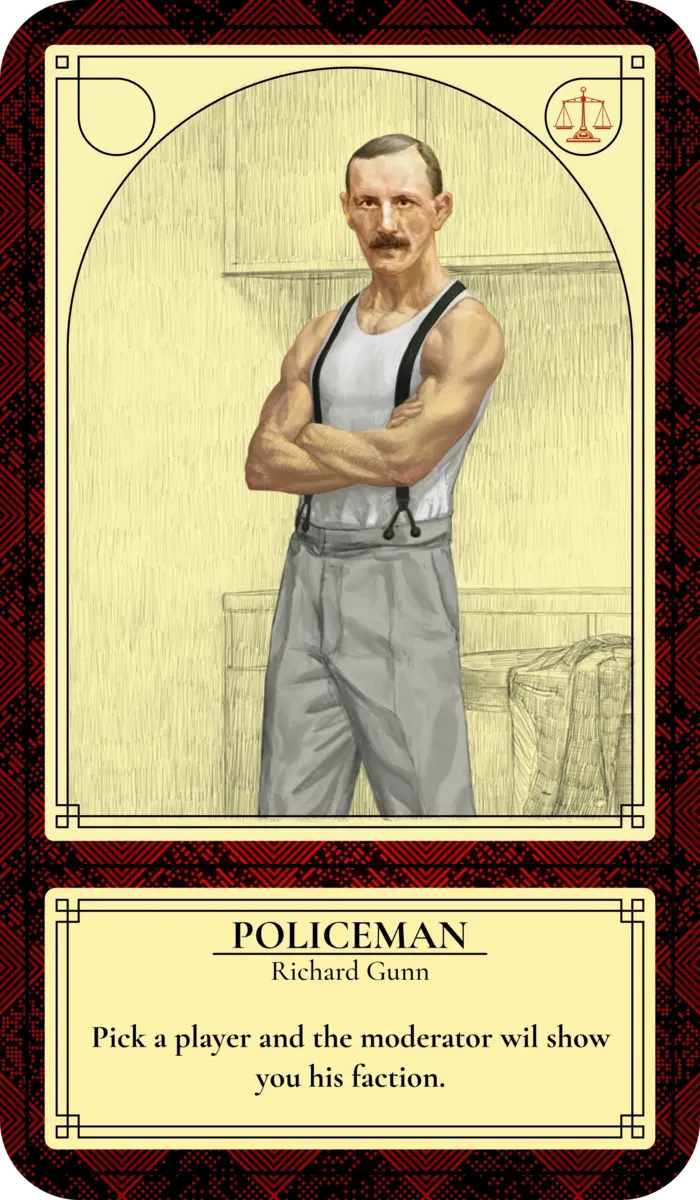
City: 1 Policeman, 1 Doctor, Citizens to fill Mafia: 2 Assassins
The classic table of nine. Two killers, a cop, a doctor — and the vote does the rest.
City: 1 Policeman, 1 Doctor, Citizens to fill Mafia: 2 Assassins