What this card does
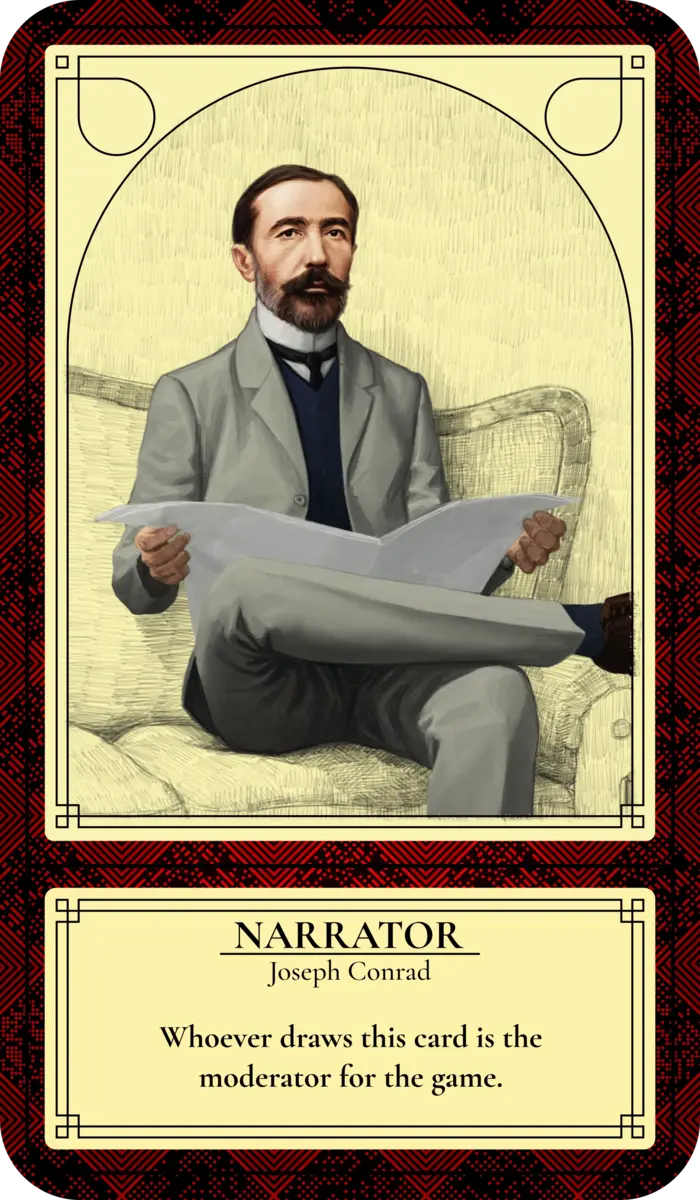
Whoever draws this card is the moderator. You are not City and not Mafia. You run the night and the day.

Host Day No night job
What this card does
Whoever draws this card is the moderator. You are not City and not Mafia. You run the night and the day.
How to play
Whoever draws this card is the moderator for the game.
You are not City and not Mafia. You run the night and the day.
Wake roles. Say who died. Count the votes. Do not take a side.
Tips
The Narrator is one of the mafia roles in the mafia party game.
How to host
This card is not dealt into a City or Mafia list. You sit out of both teams and run every night and every day. The spoken lines live on one page so you can read them instead of inventing them in the dark.
East End lore
Whoever draws the Narrator runs the game. They see every card, know every killer, and must tell the story without giving it away. Joseph Conrad wrote some of the greatest novels in English in his third language, one he did not speak fluently until his twenties. He spent twenty years at sea before publishing a word, earned a master mariner's certificate, and took a river steamer up the Congo and came back with a view of Europe he could never put down. Nearly all his novels work the same way: one man tells another a story, secondhand, at night, and the reader is left to judge what the teller has understood. That is the Narrator: the only person at the table who knows the truth, and the one you can never be quite sure of.
In the lore, nobody recruited Conrad. He came on his own, a novelist with a notebook who wanted to know what had happened to some men he admired. He sat with a prisoner in a cell and an old man in a chair, and he believed each of them in turn. He could have sold either one to the newspapers and did not. He gave his word and kept it, and was paid for keeping it in other men's confidences. By the end he had a police file inside his coat that nobody else was allowed to see. He trimmed the lamp and untied the tape.
“I was present at everything and party to nothing. I believed that made me safe.”
Joseph Conrad
Street
Someone has to keep the story straight. In 1900 that was a clerk, a priest, a publican — anyone the room would still listen to.
Meeting
Someone has to keep the night in order and the day honest. This card is how the table knows who that person is.
The room
Players will push you for a look, a nod, a name. The hidden cards only work if you give them none.
Inspired by
1857–1924
He wrote some of the greatest novels in the English language, and English was his third language. He did not speak a word of it fluently until he was in his twenties. Polish first, French second, then English — learned at sea, from sailors and cargo manifests, in a merchant fleet where nobody was teaching him. He spoke it with a heavy accent for the rest of his life and was sometimes difficult to understand in conversation. On the page he was unimprovable. He is one of the very few writers in history to reach the first rank in a language he acquired as an adult.
He spent twenty years at sea before he published anything. He worked the ships from ordinary seaman upward, sat and passed the British examinations, and earned a master mariner's certificate, which meant he was qualified to command a British vessel anywhere in the world. He sailed to Australia, the Caribbean, Southeast Asia. He took a river steamer up the Congo in 1890, into the private colony of a Belgian king, and saw what was being done there to extract rubber; he came back with dysentery, malaria, and a permanent view of European civilisation that he could never afterwards put down. His novels are almost all built the same way: a man tells another man a story, secondhand, at night, and the reader is left to judge what the teller has understood and what he has not. He wrote a novel about anarchist bombers and police informers in London, and a novella about a company man dying up a river, and both of them are stories about what a witness gets wrong.
He was orphaned into it. Born in Russian-ruled Poland to a father who translated Shakespeare and conspired against the Empire, he was four when the family was deported to northern Russia for that conspiracy. His mother died of tuberculosis there. His father died a few years after their return, and Poland turned out for the funeral. Conrad was eleven, in the care of an uncle, in a country that officially did not exist. At sixteen he left for Marseille and the sea, which was the one thing available that had no nationality attached to it at all.
He settled in England, took citizenship, married, wrote in poverty and near-permanent ill health for years before the money came, and died of a heart attack in Kent in 1924. He turned down a knighthood. His books are still argued over, and the argument is always about the same thing: what the narrator saw, and what he was capable of saying.
Forget the twenty years at sea and the master's certificate. Remember only this: he built a career on the principle that a story is only ever as reliable as the man telling it — and he made certain you would never quite know how far to trust him.
Mafia is easier to play than it looks. Everyone gets a hidden card — most of the table is City, a hidden few are Mafia. At night the killers quietly pick a victim while a doctor tries to guess who needs saving and a cop digs for the truth. By day the survivors argue about what happened, put someone on trial, and vote. The City wins by finding every killer; the Mafia wins by surviving until they can win a vote. The walkthrough takes you through the whole game, from the deal to the last trial.
How to play mafiaYour first game should be The Lamp and the Lancet — eight players and only three night wakes, so nobody gets lost. With a ninth chair the same deal becomes, naturally, The Ninth Chair. All twenty published deals, up to twenty-seven players, are on the setups page.
The teaching deal. Eight chairs, one lamp, one lancet — and two knives that already know each other.
City: 1 Policeman, 1 Doctor, Citizens to fill Mafia: 2 Assassins
The classic table of nine. Two killers, a cop, a doctor — and the vote does the rest.
City: 1 Policeman, 1 Doctor, Citizens to fill Mafia: 2 Assassins